Explain PDR to Customers: Technician Scripts
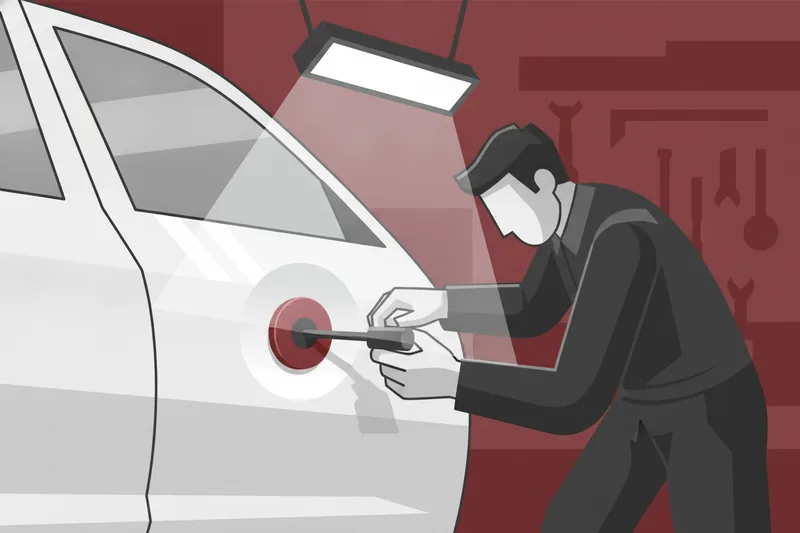
Explaining paintless dent repair to a skeptical customer comes down to three things: a plain-language description of the process, an honest account of what it can and can't do, and a straight answer on cost, timing, and insurance. This guide gives you the actual scripts — what to say when someone doubts a "no paint" repair will hold up, why the price is what it is, and how to prove the work before you hand back the keys — built around the real glue-pull process, temperature-matched adhesives, and internal-access tools you already use on the panel.
What Is Paintless Dent Repair? Explaining It in Plain Terms
Paintless dent repair (PDR) is a set of professional methods used to restore the shape of a qualifying metal panel through controlled movement while keeping the existing, serviceable paint finish in place — no removing and reapplying it. The method has been around since a Mercedes-Benz employee, Oskar Flaig, first demonstrated it publicly in 1960, and it works on both steel and aluminum panels. Customers hear "paintless" and assume nothing but metal is involved; it's worth clarifying that the finish isn't touched, even though materials like hot-melt adhesive, cold glue, cleaning agents, and protective films are routinely part of the job. That distinction alone defuses a lot of confusion at the counter.
One common technique inside PDR is glue-pull dent removal: a strong adhesive bonds a plastic tab to the outside of the dent, and a pulling tool draws the metal back into shape from the front, rather than pushing it from behind with rods. This is what makes it possible to fix double-skinned panels, sealed structural sections, or areas blocked by internal bracing — spots where a technician simply can't get behind the panel. It's also the backbone of most hail damage repair programs, alongside door dings, creases, and feature-line dents. Since glue adhesion is the one variable a technician can't fake their way around, reliable materials matter — it's why shops running high dent counts standardize on a consistent cold-glue system like Glexo's rather than mixing whatever's on hand. Explain it this way and the customer understands immediately: no sanding, no filler, no repaint — the metal moves, the paint stays.
How Does PDR Work, Step by Step (A Customer-Friendly Walkthrough)
Walk a customer through the process the same way you'd walk yourself through it on the panel — but skip the technical branching. In practice, the repair isn't a rigid checklist; a technician moves between rough correction and fine finishing as the panel responds, sometimes stepping back to reassess before continuing. You don't need to explain that nuance in full, but it's useful background for why you might spend more time on one dent than another that looks identical.
Preparing and Cleaning the Panel

Every repair starts with cleaning the work area thoroughly. Contaminants, wax, or coatings left on the surface weaken adhesion, so a proper wipe-down — Glexo's SPS wipes are built for this kind of deep clean before glue goes on — sets up everything that follows.
Applying the Glue-Pull Tab
Once the surface is ready, the technician applies a cold glue tab sized and shaped for the dent. Cold glue behaves differently depending on shop temperature, which is why professional cold-glue lines are split by working range — for example, a formula rated up to roughly 86°F (30°C) and a separate one for hotter conditions — so the glue tacks and releases predictably instead of guessing.
Pulling the Dent Back Into Shape
With the tab set, a slide hammer or mini-lifter applies steady outward pulling force until the metal returns toward its original contour. It's worth noting for the technically curious customer that a slide hammer only counts as part of a proper PDR process when it's paired with a nondestructive, PDR-compatible attachment and technique — it's not just yanking on the panel.
Reaching Tight Spots with Internal-Access Tools
Some dents sit where no glue tab can reach — behind trim, in tight ribs, or on stretched high spots. That's where internal-access tools like Sonic tips come in: a Glexo tool line named for its shape, not for sound or vibration, offered in soft, rounded heads for gentle pressure work and sharp heads for short, precise strikes on stubborn metal. Reading the panel under a proper repair light — a dedicated reflection and illumination setup, not a shop bulb — is how technicians judge progress at every stage.
PDR vs Traditional Body Repair: Benefits Worth Highlighting
Traditional body repair — sanding, filling, priming, and repainting — is the comparison every customer implicitly makes. PDR skips that chain entirely on a qualifying panel: no sanding, no body filler, no repaint, which keeps the factory finish intact and avoids the environmental load of new paint and solvents. That's the headline benefit worth stating plainly, followed by turnaround and cost, since a paintless repair generally clears faster and cheaper than a full refinish because there's no paint booth, no cure time, and no color-match risk.
Frame the "why not always" honestly, too. Repairability isn't just about how big the dent looks — it's a function of depth and sharpness, how far the metal stretched, panel material, finish condition, access from behind, and nearby components, not size alone. Sometimes a technically doable PDR pull isn't the smart call anyway — if access work or removal/reinstallation would eat more time than the dent is worth, conventional repair may be more economical even though PDR could work. And when a panel's finish is already compromised, PDR-based tools can still be used to reduce the metal damage before painting — a hybrid path called "push to paint," which minimizes filler even though it isn't a full paintless result. Some advanced hybrid approaches combine backside pushing, glue pulling, and controlled techniques while still keeping the finish intact and requiring no refinishing — meaning they still qualify as full PDR. The distinction matters for setting the right expectation before you start, not after.
What PDR Can't Fix: Setting Honest Expectations
Credibility comes from stating limits before the customer discovers them. PDR doesn't guarantee an invisible, factory-perfect result on every job — say that upfront rather than promising perfection and hoping. Paint that's already cracked, chipped, or previously repainted can inhibit a successful pull, since the process depends on an intact, flexible finish. Sharp creases and metal stretched past a workable point usually push a job toward conventional repair instead.
Before starting, agree with the customer on the actual quality target — full PDR, best-achievable improvement, or prep-for-paint — rather than assuming full correction and quietly redefining "done" if the result falls short. Never describe an incomplete repair as "90% perfect" without that standard having been set in advance — it's a fast way to lose trust. Some of the finishing work itself involves gently tapping down high spots with a light, non-marring hammer to blend ridges, which is exactly what a Glexo blending hammer of the right weight is built for — a normal, expected step, not a sign something went wrong.
Handling Common Customer Questions and Objections
"Will You Be Able to Tell There Was Ever a Dent?"
Answer honestly, not aspirationally: on a qualifying panel, the goal is a result indistinguishable to the eye under normal viewing, but perfection isn't guaranteed on every dent, and you'll say so before you start rather than after. Agreeing on the target result upfront — full correction versus best achievable — is what protects both of you if the metal doesn't return all the way.
"Why Does This Cost What It Costs?"
Customers comparing PDR to a body-shop quote often assume "no paint" means "cheap." Reframe it around skill and equipment: precise glue application, temperature-correct adhesives, internal-access tooling, and the time spent reading the panel under proper light are what the price reflects, not a shortcut. It's still very likely to land below a full repaint, but it isn't free labor.
"Will My Insurance Cover This?"
For hail and comprehensive claims, PDR is frequently the preferred repair method insurers authorize because it restores the panel without a full repaint — but coverage specifics depend on the policy and the adjuster's assessment, not on you. Tell the customer plainly that you can document the damage and repair for their claim, but the coverage decision itself sits with their insurer.
How to Prove and Show Repair Results
Nothing builds trust like showing the work, not just describing it. Do a walk-around under a proper repair light before and after — but remember that clean, straight reflected lines under one lighting setup don't by themselves prove a complete repair; a normal visual inspection without that light is also part of confirming the result. Photograph and, where practical, video the panel from multiple angles for the customer's own records and for insurer documentation — useful evidence, though a customer's account of prior paint or repair history is treated as supporting evidence, not conclusive proof of what's underneath. If any removal and reinstallation was needed to access the dent, verify fit and gaps, seals, electrical connections, and any required calibration or road test before calling the car done — and if the repair touches a structural area, remember that cosmetic improvement alone doesn't confirm structural integrity has been restored; that requires following the OEM's published procedures. On hail jobs specifically, a proper assessment produces three distinct outputs worth showing a customer: a damage inventory, a repairability determination, and the resulting estimate — walking them through all three, not just a final number, makes the process feel transparent rather than arbitrary.
Communicating Cost and Turnaround Time
Set expectations around a process, not a promise. The underlying repair process — moving through inspection, repairability assessment, documented scope, repair, restoration, and final QC before delivery — doesn't change whether you're a retail counter, a mobile unit, or a dealership program, even though a technician may move between these stages nonlinearly as the panel responds; only the order of administrative handoffs shifts. That's useful to say aloud: "the steps don't get skipped just because it's a hail job" reassures a volume customer that speed doesn't mean corners cut, and it holds even at wholesale volume — pricing pressure never justifies skipping paint checks, safety warnings, or required calibration.
Give a completion window, not a calendar date, since parts, insurer approval, and shop workload all affect it. And be careful with "PDR complete": on multi-panel or hail jobs, that milestone doesn't mean the car is ready for delivery if reassembly, glass, calibration, or the invoice is still open — say so plainly so a customer doesn't show up expecting keys the moment the dents are gone.
Frequently Asked Questions About Explaining PDR to Customers
How does PDR actually work, in one sentence? A technician cleans the panel, bonds a tab or accesses the dent internally, and gently pulls or works the metal back toward its original shape without sanding, filling, or repainting the surface.
What are the downsides of PDR? It can't fix already-cracked or repainted finishes, severe creases, or metal stretched beyond a workable range, and it doesn't promise a factory-perfect result on every dent — set that expectation early rather than let it surprise the customer later.
Does PDR require real skill, or is it a shortcut? It's a distinct trade skill — reading panel geometry, matching adhesive to temperature, and controlling pressure by feel — not a faster, lesser version of bodywork. The quote for a PDR job typically reflects vehicle and panel details, damage geometry, access work, and materials, the same categories that go into any professional repair estimate.
What's a realistic example? A hail-damaged hood with a dozen shallow dents, cleaned and pulled panel by panel with temperature-matched cold glue and finished with a blending hammer, versus a door with a sharp crease and already-chipped paint that needs conventional repair instead. Framing PDR's advantages — speed, cost, preserved finish — as things that apply when a panel qualifies, rather than universal guarantees, keeps every conversation honest.
Confident conversations start with reliable results on the panel. Back up what you tell customers with professional-grade equipment — explore Glexo's cold-glue systems, Sonic tips, and full PDR tool lineup built for faster, cleaner repairs.