PDR Glue System for High-Volume Shops | Speed & Efficiency
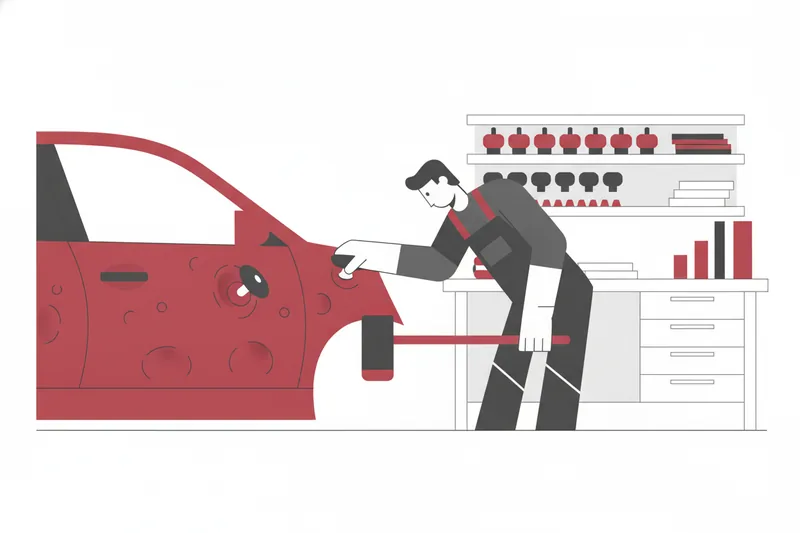
Downtime between pulls is what separates a hail-repair shop that clears 40 dents a day from one that clears 15 — and most of that gap traces back to the glue system, not the technician's hands. A PDR glue system built for volume work means temperature-matched cold glue, redundant tabs sized to the job, and a surface-prep routine fast enough to keep pace with continuous pulls, all sequenced so no single failed bond stalls the line.
What Is a PDR Glue Pulling (GPR) System?
Glue pull repair (GPR) is a paintless dent repair method that bonds a tab to the exterior finish with adhesive, then applies controlled force through a pulling device to draw the metal back toward its original shape — no drilling, no welded studs, no removing the coating just to get an attachment point. It's worth being precise with the term: I-CAR defines GPR specifically as a conventional straightening technique, and the label isn't automatically synonymous with a fully paintless outcome — the finish result still has to be stated case by case.
Core components: tabs, glue, and puller
Three parts make the system work: glue tabs (metal or plastic pieces shaped to distribute pulling load across the low point), the adhesive itself — either cold glue or hot glue — and a glue puller, most often a slide hammer, that transfers a controlled pulling force through the tab into the panel. Shops that treat these as a matched system rather than three separate purchases are the ones that keep cycle time down, which is a large part of why manufacturers like Glexo build cold-glue systems around tab redundancy and temperature-matched compounds rather than selling glue and tabs as unrelated line items.
How a glue pull differs from access-hole or lever repair
Traditional PDR pushes or levers a dent from behind the panel. Glue pulling works from the outside, which makes it the practical option when the backside is sealed or blocked — double-skinned panels, structural sections, or areas behind internal bracing — and it's also commonly used on aluminum panels and larger dents or creases where backside rods fall short. Some repair plans combine both: backside pushing paired with exterior glue pulling and knockdown work, a hybrid approach that can still qualify as full PDR provided no filler or refinish is required. Note too that both PDR and GPR are classified by I-CAR as cold straightening — if an OEM prohibits cold straightening on a given part, that restriction stands regardless of the panel's location.
Cold Glue vs Hot Glue: Which Is Faster for Volume Work
The core difference is what happens between pulls. Hot glue is melted with a glue gun, bonds rock-solid, and can generate serious pulling force on stubborn or deep dents — but each tab needs reheating to remove and reapply. Cold glue is a ready-to-use, tacky compound applied straight to the tab with no heat gun at all; it's designed to peel cleanly off the panel and go back onto the next tab, reused pull after pull as long as its condition holds up.
That reworkability is exactly why cold glue dominates hail-kit workflows: a technician moves from tab to tab without waiting on a gun to melt, cool, and reset. Cold glue also suits broad, shallow damage and crown manipulation well, though hot glue still has the edge for pinpoint, very deep micro-dents. Neither method is a fixed first-or-second step — the repair plan, not a house rule, decides which adhesive goes down first. And regardless of which one is running, a pull gets stopped the moment the finish changes, adhesion turns unpredictable, secondary damage appears, or the temperature behavior stops matching the product's spec.
Why High-Volume Shops Need a Dedicated Glue System
Ad hoc tool drawers — a few tabs, one glue type, one puller size — work fine for occasional repairs. They fall apart under hail-volume conditions, where dozens of dents per panel and back-to-back vehicles turn every failed bond into measurable downtime: a technician stops, cleans a tab, reheats or reapplies, and re-pulls, while the rest of the job queue waits.
A dedicated system addresses this with redundancy built in from the start — enough prepped tabs in the right sizes, and enough glue on hand in the temperature variant the shop is actually working in, that a single bad tack doesn't halt the line. The goal isn't a faster individual pull; it's a lower cycle time per dent across the whole job, which is what actually moves a shop's daily throughput number.
Choosing Tabs and Tools for Hail and High-Volume Jobs
Tab selection has to account for the shape and scale of the low point, the panel's curvature, the direction the load needs to travel, how stiff or flexible the tab itself is, and whether it's physically compatible with the neck, adapter, and puller in use — plus the panel material. None of that reduces to a size shortcut: there's no valid rule that says large dents always start with a large tab and step down, only the broader principle that broad contact suits bulk movement and localized contact suits precision.
Standard tabs vs mini/hail tabs
Mini/hail tabs are the smaller-diameter version used across a hail panel's dense field of shallow dings, where dozens of small, localized pulls matter more than one broad move. Standard tabs stay in play for larger, more isolated dents where the load needs to spread across a wider area. A proper hail assessment — cataloguing the damage, confirming what's actually repairable by PDR versus replacement, and calculating the job under whatever estimating matrix applies — should come before tab counts are finalized, since it determines how many mini tabs a job actually consumes.
Slide hammer weight and tip considerations
The slide hammer has a documented role in hail and roughing work, but lighter or smaller variants are better suited to precise pulls — the tool category isn't locked to one damage size. That also means "hail equals slide hammer, full stop" is an oversimplification to avoid: matching the puller to the specific dent, not the job category, is what protects the finish and the load path. For broad or large-area damage, the realistic candidate list also includes beam or bridge pullers and hybrid approaches, supported by adequate lighting and panel support to see and control the pull.
Temperature Ranges and Glue Selection Guide
Ambient and panel temperature change how cold glue tacks and holds, which is why cold-glue systems are typically offered in separate variants — one built for ambient temperatures up to roughly 86°F/30°C, and a second for use above that threshold, since adhesives generally lose stability as heat climbs. A glue gun's dial setting is a separate thing entirely from the actual bond temperature at the panel, and a setting that works for one brand's stick doesn't transfer to another's — so the glue itself, not just gun heat, has to match the working conditions.
Set-time table by temperature range
Exact set times are product-specific and belong on that product's technical sheet rather than a universal chart, since cold glue is not a standardized chemistry across brands. As a working framework:
| Ambient condition | Glue variant | What changes |
|---|---|---|
| Up to ~86°F/30°C | Standard cold glue | Predictable tack within the product's rated window; typical shop-floor behavior |
| Above ~86°F/30°C | High-heat cold glue variant | Formulated to resist premature softening or slump as ambient heat rises |
Keeping both variants stocked, and matching the one in use to the actual bay temperature rather than the calendar, is what keeps adhesion consistent through a hot afternoon versus an early morning.
Surface Prep Steps for Reliable Adhesion at Speed
Cleaner/prep, adhesion promoter, and release or removal solution are three distinct functions in a glue pull, even when a single wipe or product handles more than one of them. SPS surface-prep wipes exist to do the deep-clean step fast — stripping wax, road film, and light contamination right before glue goes down — while an anti-adhesive film protects surrounding panel area from stray adhesive during the pull.
Prep isn't optional busywork on a fast job; it's what keeps the redo rate down. Glue-based repair can preserve the exterior coating better than weld-on pulling, but that process advantage doesn't guarantee adhesion to every finish. Unknown refinish history, filler beneath the surface, cracking or delamination, matte or satin coatings, ceramic sealants, PPF, wraps, or exposed corrosion all call for extra caution before committing to a pull. On a previously repainted panel in particular, adhesion is less certain and hidden filler changes how the repair behaves, which means the customer needs to be informed before work starts, not after a tab fails.
Step-by-Step Glue Pull Workflow for Maximizing Throughput
- Prep the panel. Deep-clean with an SPS wipe and confirm finish type — refinish, coating, or film history changes the plan.
- Confirm compatibility. Before gluing anything, check that the finish suits the cleaner/promoter, the adhesive suits the tab and the gun (if hot glue), the tab suits the panel, and the tab neck matches the adapter and puller.
- Apply glue to the tab — cold glue goes on directly with no gun involved; hot glue is melted and laid down fresh.
- Twist or press the tab onto the dent center, so load runs cleanly from the puller through the adapter and glue into the panel.
- Attach the slide hammer and pull along the correct axis. An off-axis pull can displace the surrounding area, and a slide-hammer's sharp impulse gives a different control profile than a sustained lifter or beam pull — pick the one the dent calls for.
- Reassess before the next pull. Response depends on tab area, compound thickness, temperature, contact time, pull rate, and how much the compound has already been used — no two pulls behave identically, even with the same tab.
Run that sequence with enough prepped tabs and matched glue on hand, and the limiting factor on dents per hour becomes technician pace, not waiting on a reheated stick or a tab that failed mid-pull.
FAQ: Set Time, Strongest Glue, and Cost Comparisons
How long should PDR glue set before pulling? There's no single number — set time depends on the specific product and the ambient/panel temperature it's rated for. Check that product's technical sheet rather than applying a fixed rule across brands.
What is the strongest PDR glue? There isn't one universal answer. Hot glue can generate significant pulling force for stubborn, deep dents, while cold glue's advantage is reusability across broad, shallow hail-style work. Tab color or surface texture is not a standardized strength rating, so choose by application, not by how a product looks.
Cold glue vs. hot glue cost over volume? Cold glue's reusability — peeling off and going back onto the next tab without a fresh stick or a reheat cycle — tends to lower the per-pull consumable cost on high-repetition hail jobs. Hot glue consumes a new stick per bonded area, which adds up faster across hundreds of dents, even though it remains the better tool for specific deep-dent cases.
When should a shop restock tabs and glue for continuous jobs? Since a tab's and compound's response changes after repeated use, high-volume shops keep spare mini/hail tabs and both temperature variants of cold glue on hand before a job starts, not mid-job — running out mid-panel is exactly the downtime a dedicated glue system is meant to prevent.
Stock your shop with Glexo's temperature-matched cold-glue systems, hail tabs, and SPS wipes — built for continuous, high-volume PDR work — and ask about the regular-customer discount for bulk orders.