PDR Pricing Guide: Cost Model for Repairs | Glexo
PDR pricing isn't a lookup table — it's a calculation. A fair, defensible price for any paintless dent repair comes from three things multiplied together: how long the pull actually takes, how hard the panel is to reach and finish safely, and what the job consumes in tabs, glue, and tool wear. Shops that quote from memory or from a competitor's rate card are usually leaving margin on the table or pricing themselves out of hail season work. This guide builds a repeatable cost-per-repair model — not a consumer price chart — so you can defend every number on your rate sheet.
What Actually Drives PDR Pricing
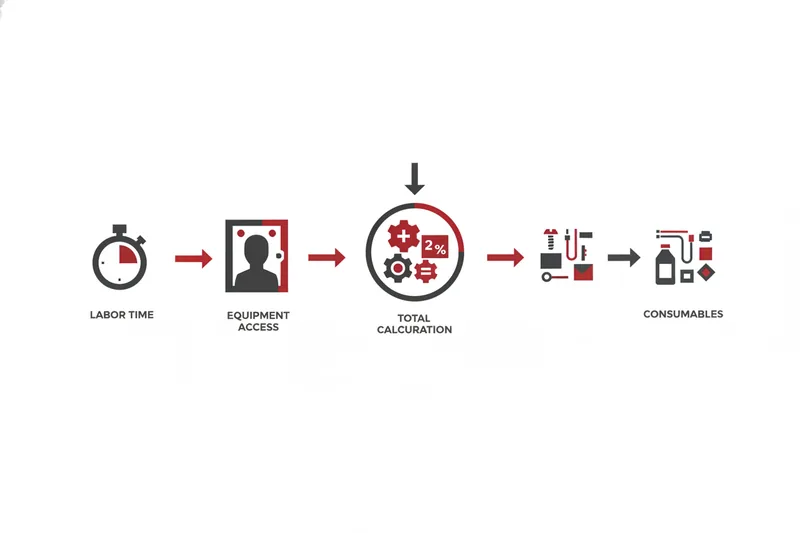
Paintless dent repair (PDR) is a set of professional methods that restores a panel's shape through controlled metal movement, keeping the existing factory finish intact rather than removing and reapplying it. That's the value proposition to the customer, but it's also the reason pricing has to be modeled, not guessed: every job trades finish preservation against time, access, and material.
Labor time per pull
Time is the single biggest cost driver in PDR, and it isn't uniform across dents of the same size. A sharp dent — one with a small radius or concentrated center — raises the bar on finish inspection, precise tip or tab sizing, the heat decision, and the pace of correction needed to avoid stress cracking the clear coat. A shallow, broad dent on a flat panel can take a fraction of the time a sharp crease near a bodyline takes, even though both might look similar in a photo.
Panel access and complexity
Repairability isn't just about dent size. It depends on depth and sharpness, how much the metal has stretched, where the damage sits relative to bodylines and edges, panel material, prior repair history, backside access, nearby structural or safety components, and OEM restrictions on that panel. When access or removal-and-install (R&I) work dominates the job, or finish risk is high, a technically possible repair can still be economically irrational to take on at a flat rate. This is exactly why shops that build tool inventories — Glexo's cold-glue systems and Sonic tips among them — treat access difficulty as a line item in the cost model, not an afterthought.
Consumable and tool cost per repair
Every pull consumes something: a cold-glue tab, a dose of adhesive, a wipe of surface-prep solution, tool wear. PDR is non-invasive by design — qualifying repairs skip sanding, filler, and repainting entirely — but that only holds true if adhesion and access work correctly the first time. A wholesale price or high job volume never justifies skipping paint assessment, cutting corners on access, or ignoring a required protection step just to hit a number. Consumable cost per job is real and belongs in the price, even when it looks small next to labor.
Average PDR Cost by Dent Size
Dent-size charts are the most common thing customers find online, and they're useful as a rough public reference — but they're a starting point, not a pricing model. Small, shallow dents on flat panels sit at the low end of most shops' rate sheets because they're fast and low-risk. Larger dents, sharp creases, or anything near a bodyline or crown moves into a higher tier — not just because it's bigger, but because sharp damage demands slower, more careful correction to protect the finish.
What these charts consistently miss is R&I. Removing and installing trim, headliners, or lamps to reach a dent is not automatically bundled into a "per dent" price — it has to be assessed and quoted separately. A shop that prices strictly off a size chart without checking for hidden R&I work is quoting against its own margin before the job even starts.
PDR Cost for Hail Damage: Hail Kit Economics
Hail work is where per-dent pricing breaks down fastest, because a hail-damaged vehicle isn't one dent repeated fifty times — it's a portfolio of damage with simultaneous variation in panel material, dent count, size, depth, sharpness, bodyline involvement, coating condition, and access, sometimes with implications for glass, trim, or ADAS systems. A proper hail assessment produces three distinct outputs: a damage inventory, a technical repairability determination, and a separate estimate calculation under whatever matrix applies. NAPDRT guidance is explicit that this assessment should happen on a cleaned vehicle indoors, under professional PDR lighting, not in a parking lot glance-over. A full hail map also needs to note oversize or severe damage, panels needing conventional repair or replacement, and any prior unrelated damage on the vehicle.
This is where hail kit economics matter. High-volume hail work runs through tabs and cold glue fast, and shops that stock in bulk — through hail kits and smaller micro kits for tight or delicate access points — lower their per-tab and per-dose cost significantly compared to buying piecemeal. That per-unit saving is real margin on a 40-panel hail job, but it only pays off if the shop is tracking consumable spend per vehicle, not per case of tabs.
Insurance-Covered vs Out-of-Pocket PDR Pricing
An insurer's PDR matrix calculates a price; it does not determine whether a given panel is repairable, and it does not authorize the technical repair itself. That distinction matters for pricing because it means insurance-negotiated rates and a shop's own cost-based rate sheet are answering two different questions. The matrix tells you what the insurer will pay for a defined operation under a specific agreement; your own model tells you what the job actually costs you to perform profitably.
A complete, defensible final quote — insurance or out-of-pocket — needs to account for vehicle and panel identity, damage type and geometry, finish and repair history, access and itemized R&I, any OEM-required operations, glass or calibration needs, consumables, taxes and fees, and stated assumptions or exclusions. Shops that quote flat "per dent" numbers regardless of payer type are the ones most likely to get squeezed on supplements later, because nothing in the original quote documented what wasn't included.
How Much Should PDR Technicians Charge? A Pricing Guide for Shops
Pricing per technician-hour is the more honest way to think about PDR rates than pricing per dent, because your actual earning rate depends on how fast and how reliably you can complete a repair to a passing standard — not just what you charge for it.
Faster tools, fewer redos, higher effective hourly rate
The math is straightforward: if a cold-glue system with reliable tack lets a technician complete a pull in less time and without a second attempt, the effective hourly rate on that job goes up even at an identical quoted price. Sonic tips, sized and shaped for internal access, reduce the setup time needed to reach tight areas from behind a panel. Blending hammers of the appropriate weight settle metal faster during finishing without overworking the paint layer. Knockdown tappers with a mirror-polished tip reduce the chance of a mark that turns a one-hour job into a two-hour job with a paint touch-up on top. None of this shows up on a dent-size chart, but it shows up directly in your margin.
Matching tool cost to job type
Not every job justifies premium tooling, and not every job tolerates cheaper substitutes either. Mobile PDR runs under the same repairability rules as shop-based PDR — it does not mean glue-only work, no R&I, no controlled lighting, or skipped protection steps just because the technician is working out of a van. A panel-only PDR price by itself doesn't automatically include R&I for trim, seats, lamps, or glass, scanning or calibration, corrosion protection, or glass work — all of that has to be priced as its own line, tool cost included, whether the job is in a shop bay or on a lot.
PDR Price Estimate Calculator / Price Matrix
A usable internal price matrix goes further than a dent-size lookup. Build it around three variables per job type: time-per-pull (from your own job logs, not industry averages), consumable and tool cost per pull, and a panel-access multiplier that separates Sonic-tip work from straightforward hammer-and-tap work, since access difficulty changes both time and redo risk.
A basic per-repair formula looks like this:
- Labor cost = time-per-pull × your shop's target hourly rate
- Consumable cost = tabs, glue dose, and surface-prep wipe cost for that pull
- Access adjustment = multiplier for backside access, R&I, or panel curvature
- Cost-per-repair = labor cost + consumable cost, scaled by the access adjustment
Keep this matrix internal and separate from any insurer's calculator. A PDR matrix and its outputs depend on the specific insurer, vehicle profile, program version, and agreement in force — it answers a pricing question only, and doesn't establish repairability or authorize the repair. If you publish an online estimate tool for customers, state plainly that it's non-binding, flag what information is missing, and never present the lowest-cost scenario as a firm quote.
How to Build Your Own PDR Price Guide
Turning this model into a written guide is a tracking exercise before it's a pricing exercise.
- Log time-per-pull by job type for a few weeks — small door dings, sharp creases, hail panels, internal-access jobs — instead of estimating from memory.
- Track consumable cost per job, including cold-glue tabs, glue dose, and SPS surface-prep wipe usage, since wipe consumption scales with panel count on hail jobs even though it's a small per-unit cost.
- Separate tool categories in your cost model. PDR tooling isn't limited to glue-pulling and metal-working gear — rods and whale tails, LED reflector boards, tap-down pens, and knockdown or body files each serve distinct functions and carry their own time and cost profile. There's no established industry ranking or mandatory kit that applies to every shop, so build the guide around what your shop actually runs.
- Set tiered rates by time-per-pull and access difficulty, not dent size alone.
- Revisit the guide quarterly. If a faster cold-glue system or a better-suited Sonic tip cuts your average pull time, that efficiency gain should move into your rate sheet as margin, not get absorbed silently.
FAQ
How is PDR calculated? PDR pricing is calculated from labor time per pull, panel access and complexity, and consumable/tool cost — not from a fixed size chart. A complete quote should also account for R&I, any OEM-required operations, glass or calibration work, and stated exclusions, since repairability itself depends on a wider set of factors than just how big the dent looks.
What's a reasonable rate for a PDR technician to target? There's no single industry-standard number, because it depends on your market, your tool efficiency, and how much of each job is labor versus consumable and access cost. The more useful target is effective hourly rate — what you actually earn per hour worked once redo rate and setup time are accounted for — rather than a flat per-dent figure.
Does insurance cover PDR? Often, yes, but the insurer's PDR matrix only calculates a price under its own agreement — it doesn't determine whether a panel is repairable or authorize the technical repair. Out-of-pocket work should be priced against your own cost model, not the insurer's matrix.
How is hail damage priced differently? Hail pricing has to treat the vehicle as a portfolio of varied damage — not one dent multiplied — because panel material, dent size, sharpness, and access all vary across the same car. A hail estimate should separate the damage inventory, the repairability determination, and the price calculation into distinct steps rather than quoting a flat per-dent number across the whole vehicle.
See how Glexo's cold-glue systems, Sonic tips, and hail kits can lower your cost-per-repair — browse the catalog and ask about regular-customer discounts to build your own profitable price guide.