How to Price Paintless Dent Repair | Glexo
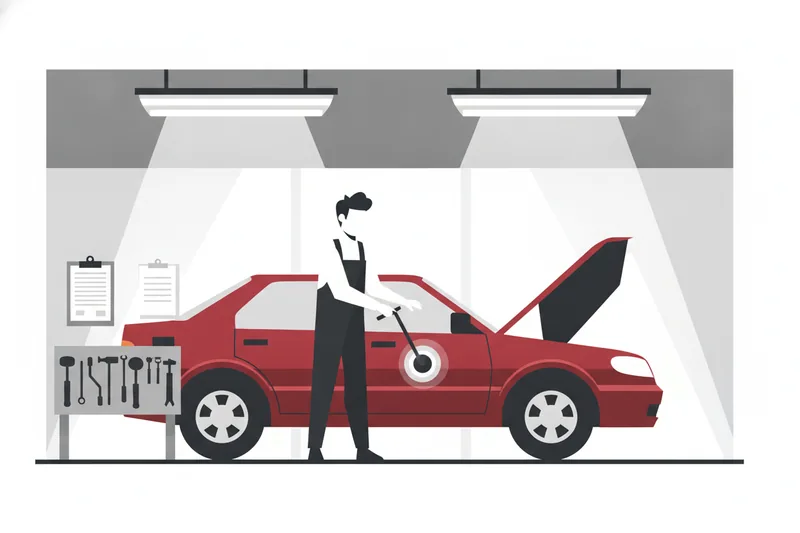
How to Price Paintless Dent Repair: A Shop Owner's Guide to Profitable Quotes
Paintless dent repair pricing is not a flat rate per dent — it is a calculation built from damage assessment, labor time, method choice, tool cost, and shop overhead, and a profitable quote reflects all five. Most pricing content online is written for car owners trying to guess what a repair "should" cost; this guide is written for the technician or shop owner who has to set that price and defend it, job after job.
What Factors Actually Determine Paintless Dent Repair Pricing
Before any number goes on a quote, the job has to be assessed technically. Repairability in PDR is determined by a system of factors — depth and sharpness, metal displacement and stretch, location and curvature, bodyline or edge involvement, panel material, finish condition, and access — not by dent size alone. That system matters for pricing because two dents of the same diameter can carry very different labor costs depending on where they sit and how the panel is built.
Dent size, count, and accessibility
Size still matters, but mostly as one input among several. A shallow dent on a flat door skin with clear backside access is a fast repair. The same size dent on a bodyline, a double-skinned section, or a panel with sealed internal bracing takes longer regardless of diameter. Count matters too: multiple dents on one panel share setup and access time, so the per-dent price typically drops as the count on that panel rises, even though the total invoice climbs.
Paint condition is a hard gate here — PDR requires the paint surface to be intact, and paint damage, stretched metal, or a panel that's already been repainted can prevent a full PDR outcome. If a dent fails that test, it isn't a pricing question anymore; it's a different repair category (conventional bodywork), and quoting it as PDR will cost you on comebacks.
Panel location and material
Steel and aluminum panels don't cost the same to repair. Aluminum work often needs dedicated tooling and process controls to avoid cross-contamination risk, which affects both labor time and equipment allocation on a job. Common, quotable applications include hail damage, door dings, creases, and body/feature-line dents — but body lines and creases generally price higher than flat-panel dings because they demand more controlled, incremental work to avoid pushmarks or over-correction.
Labor time vs skill level
Labor time is the single biggest lever in PDR pricing, and it's directly tied to technician skill. A trained technician working efficient methods, and here's where tool choice starts compounding: shops that invest in purpose-built pulling and finishing tools — the kind of cold-glue and hammer systems Glexo manufactures for professional PDR — convert faster per-pull cycles directly into either higher daily volume or wider margin per job. A less experienced technician using the same tools will still take longer, so quotes should scale with real, measured labor time per repair, not a generic "per dent" number pulled from a competitor's price sheet.
Glue-Pull vs Traditional PDR: How Method Choice Changes Your Cost Per Job
Method selection changes your cost structure as much as skill does. Traditional PDR pushes metal from the panel's backside using rods or push tools, which requires access — often meaning trim, headliners, or interior panels have to be removed and reinstalled (R&I) before the repair even starts. That R&I time belongs on the invoice whether or not it's itemized separately.
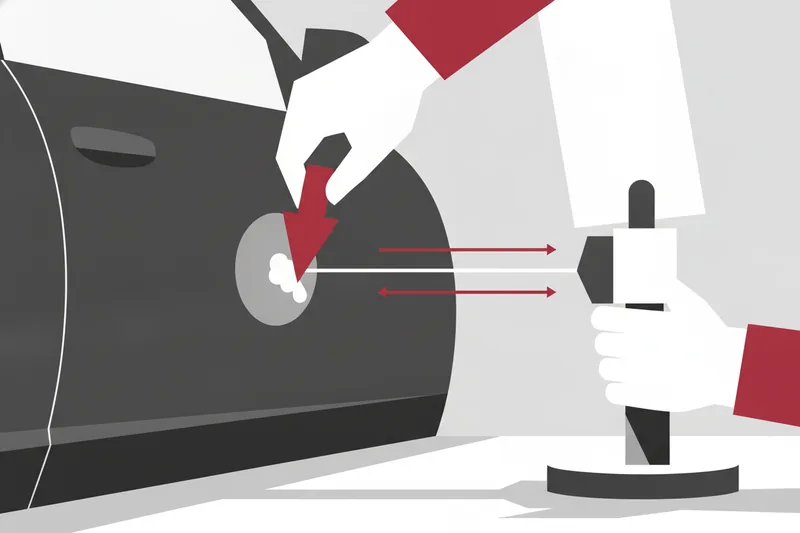
Cold glue pulling works from the outside: a compatible pulling tab is attached with a reusable tacky or viscoelastic compound, then connected to a pulling device to draw the metal back into shape. This exterior approach is commonly used where backside access is blocked — double-skinned panels, sealed structural sections like a cant or roof rail, areas boxed in by internal bracing, and aluminum panels or larger dents where conventional rod access falls short. Hot-melt adhesive pulling is a related exterior process, using a glue tab temporarily bonded with a PDR hot-melt adhesive rather than a cold-glue compound. Both are attachment methods within the same "exterior pulling" mechanical direction as opposed to backside pushing.
It's worth being precise here: neither cold glue nor hot-melt pulling is established as the industry-standard method, and the market share between them isn't documented. Glue Pull Repair (GPR) is also a specific term — I-CAR defines it as a conventional straightening technique derived from PDR, and it is not a synonym for every paintless glue pull; whether a given glue-pull job qualifies as full paintless repair depends on the finish outcome, not on the term GPR itself. Many real jobs are hybrid: backside pushing combined with exterior glue pulling and knockdown work, still finishing as full PDR as long as the existing finish stays intact and no filler or refinish is needed.
For pricing, the practical takeaway is this: when a job's access problem can be solved with a tab and a pull instead of an R&I-heavy teardown, labor time drops, which either protects your margin at the same quote or lets you quote more competitively. That labor savings is what justifies the up-front tool investment in a cold-glue system and compatible pulling tabs — it needs to pay for itself across enough access-limited jobs before it changes your effective hourly rate.
Average PDR Pricing by Dent Size and Damage Type
Common, PDR-quotable damage includes hail, door dings, creases, body-line dents, and minor collision damage. Beyond that category list, don't try to build a fixed price-per-inch table — an eight-step repairability sequence (OEM authorization, part/structural relevance, finish viability, substrate condition, damage geometry, access, achievable quality target, and economic feasibility) governs whether and how a dent is priced, with size only evaluated inside that system. A PDR matrix used by insurers answers a pricing question — it does not establish that a panel is repairable.
Single small dents vs multiple dents
A single small ding on an accessible panel is your fastest, most predictable job. Multiple dents on the same panel should be priced with a count multiplier that reflects shared setup time, not a straight per-dent rate — otherwise you either overcharge on volume jobs or undercharge on isolated repairs.
Large or crease dents
Larger dents and creases take longer and carry more risk of finish damage during the pull, which justifies a higher rate independent of surface area. Some technically feasible PDR repairs are still economically irrational to attempt at a flat rate — when access or R&I time dominates the job, finish risk is high, or a hail-damaged panel exceeds the efficient repair threshold for that estimating context. In those cases, price the job on measured time, not a size chart, and exclude anything that isn't actually a PDR damage type — scratches, paint transfer, rock chips, cracked trim, or frame damage aren't PDR line items even when they accompany a dent.
Resale value is part of the pitch behind the price: because PDR retains the vehicle's existing factory finish rather than replacing it, it avoids the paint-job disclosure that shows up in a vehicle history report — a quality customers and fleet buyers are often willing to pay a premium to protect.
Pricing Hail Damage Repair at Volume
Hail work is priced differently because a hail-damaged vehicle isn't one dent repeated — it's a portfolio of damage with simultaneous variation in panel, material, count, depth, sharpness, and access across the whole car. Pricing has to happen at three levels: the vehicle level (overall scope and dependencies), the panel level (repairability and access), and the individual damage level (method and stop criteria). You can't multiply one dent's price by count and call it a vehicle quote.
A proper hail assessment produces three distinct outputs: a damage inventory, a repairability determination, and an estimate calculation under the applicable database or PDR matrix. The damage map that feeds your quote needs panel-by-panel counts and categories, oversize or severe damage flagged separately, panels needing conventional repair or replacement, and any R&I, glass, or trim damage noted. Remember that an insurer's matrix calculates cost — it doesn't authorize the repair, and even a listed steel or aluminum upcharge in that matrix isn't technical sign-off.
For high-volume hail work, the operational reality is continuous throughput: keeping multiple prepped tabs and backup glue supply on hand so one panel's cure time or one tool being in use doesn't stall the whole vehicle. That's the logic behind hail kits built with redundant tabs and glue systems — less downtime per panel compounds into meaningfully more vehicles finished per week. Decide up front whether you're pricing per panel or per vehicle; per-panel pricing is more defensible on mixed-severity claims, while per-vehicle flat pricing only works when panel counts and severity are genuinely comparable across the batch.
Insurance Claims vs Out-of-Pocket Pricing
Quoting for insurance and quoting for a paying customer directly are two different processes. A repair facility can document damage and submit an estimate for a claim, but it cannot promise coverage or a claim outcome — that depends on the policy, the loss facts, exclusions, the deductible, and the carrier's own decision. Your rate sheet should account for that: insurance-billed work needs documentation that stands on its own (photos, damage maps, repairability notes) regardless of what the adjuster ultimately approves.
Claim categorization also has to be clean. In a catastrophe hail claim, hail-related damage, prior or unrelated damage, transport or storage damage, in-service damage, and conventional repair/replacement/glass scope must all be separated — mixing these categories creates technical, insurance, and reputational problems. Out-of-pocket customers don't need that separation, but they do need a plain-language quote they can compare against a body shop repaint estimate, which is where the resale-value argument for PDR does real work.
Negotiated insurance rates and retail out-of-pocket rates rarely match exactly, and that gap is normal — insurance work trades a lower per-job rate for predictable volume, while retail work carries the full margin but less guaranteed flow. Structure your rate sheet to reflect both realities rather than picking one number for everything.
Tool and Consumable Costs That Affect Job Pricing
Tools and consumables are a controllable input to your price, not a fixed overhead line — but they're only selected after the repair plan is set, following the repair's own requirements, never the other way around. The broader selection order runs from OEM and safety requirements down through part and substrate, finish, damage mechanics, access, and repair target, with efficiency and tool interface coming last.
Glue and tab consumable costs
Cold glue systems and tabs are a recurring line-item cost, so track them per job the same way you'd track paint materials. Because cold-glue compound is generally reusable across pulls as long as its condition holds, your real cost driver is tab consumption and prep materials, not the adhesive itself. Surface-prep wipes matter here too: deep-cleaning the panel before gluing improves tack reliability, which reduces failed pulls and redone work — a hidden labor cost that's easy to miss on a quote. Anti-adhesive films, used to protect surrounding trim or finish during glue work, are a small per-job cost that avoids far more expensive cleanup or refinish claims.
Hammer and tip investment vs job speed
Knockdown tappers and blending hammers are a one-time investment that pays back through speed on finishing and metal-settling work, provided they match the panel's material — steel tooling introduced into an aluminum repair environment can create galvanic corrosion risk, so dedicated tools and cleaning practices matter for aluminum-heavy shops. Sonic tips — Glexo's name for a family of spiked and rounded head tips used for internal access work, not an acoustic or powered device — extend what a technician can reach without additional R&I, which is a direct labor-time saving on double-skinned or braced panels.
Don't assume a blank labor entry in an estimating database means an operation is free or unnecessary — it may just mean that operation isn't included with a predetermined time and needs to be quoted separately. And keep tool-category assumptions honest: market prevalence for any given tool type isn't documented, so build your kit and your price around what your actual jobs require, not around a claimed industry standard.
How PDR Shops Should Build a Pricing and Quote Structure
A repeatable rate sheet starts with your real shop overhead — rent, insurance, software, consumables burn rate — divided across billable hours to get a baseline labor rate per hour. Add tool cost amortization on top: divide what you spent on cold-glue systems, tappers, hammers, and tips by their expected working life to get a per-job tooling cost, and fold that into your rate rather than treating it as sunk cost.
Set a minimum job charge that covers setup time even on the smallest single-dent job — a $0 minimum guarantees you lose money on small tickets. Build your quote template around the full scope of the job, not just the panel line: itemize R&I, glass, trim, and corrosion protection separately, because a wholesale price or volume discount never justifies skipping paint/material assessment, using riskier access, or omitting a required protection step. A "sublet PDR" line on a collision estimate doesn't automatically include R&I, corrosion protection, scanning, or final QC — confirm and itemize instead of assuming. And if you issue a preliminary online estimate, state plainly that it's non-binding, flag what images or data are missing, and never let a low-end range become the advertised firm price.
PDR Cost Calculator: Estimate Your Price
A professional PDR estimate is built, not guessed. A final quote needs, at minimum: vehicle and panel identity; damage type, count, size, and geometry; material and finish condition; itemized access and R&I; any OEM-required operations; glass, scanning, calibration, or corrosion-protection needs; parts, consumables, and sublet costs; taxes and payer split; and stated assumptions or exclusions.
Here's a simplified walkthrough using your own labor and material numbers as inputs. Suppose a technician's fully loaded cost — wages plus payroll burden — runs close to national PDR averages, where techs earn roughly $53,922–$68,080 a year (about $60,093 on average), and entry-level PDR work averages around $26.22 an hour. If your shop's effective labor cost is, say, $35/hour once overhead and tool amortization are folded in, and a hail panel with three moderate dents takes 40 minutes including a glue-pull setup, your labor cost for that panel is about $23. Add consumable cost (tabs, prep wipe, glue) — call it $6 — and your break-even cost per panel is roughly $29 before margin. Apply your target margin on top of that break-even figure to reach your quoted price.
If you're quoting against an insurer's PDR matrix instead of a flat retail rate, remember matrix values shift by insurer, vehicle profile, and program version — so treat the matrix as one input to reconcile against your own cost model, not as your pricing tool by itself.
FAQ: Common PDR Pricing Questions
Can PDR be done DIY, or does it need a professional? Suction-cup kits exist for shallow, accessible dings, but professional PDR pricing reflects a trained repairability assessment, panel-specific tooling, and a warranty a DIY attempt can't offer. PDR is non-invasive and doesn't require sanding, filler, or repainting when a repair qualifies — but confirming that a dent actually qualifies is the professional judgment being paid for, not the pull itself.
How should I price a first-time customer? Quote the same way you'd quote a repeat customer: full damage assessment, itemized scope, and a stated labor rate. Don't discount blind on a first job — a lower first-time rate that doesn't reflect real labor time sets an expectation you'll have to walk back later.
How do I adjust pricing for technician skill level? Tie hourly labor rate to measured speed and first-pass success rate, not tenure alone. A technician who reliably finishes a panel faster with fewer redo pulls should bill at a rate that reflects that output, and your quote template should let labor rate vary by job complexity assigned to that technician.
How do I price a mixed hail-and-collision job? Separate the categories before you price anything. A single panel amount doesn't automatically include R&I, scanning, calibration, corrosion protection, or glass work — itemize each scope separately, and never let a hail-rate assumption absorb collision-related repair that belongs on a different line.
Faster, more predictable labor time is the biggest lever you control in PDR pricing — explore Glexo's cold-glue systems, Sonic tips, and hail-kit consumables to cut labor time per job and build a pricing structure that protects your margin.