PDR Slide Hammer Guide: Choose the Right Tool
A PDR slide hammer is an inertial pulling device — a weighted slide that travels along a shaft and strikes a stop, transferring a short, sharp impulse of force into whatever it's attached to. On its own, that's just a length of steel with a sliding mass; it only becomes a genuine PDR tool once it's connected to a nondestructive, PDR-compatible attachment and process, typically a glue tab bonded to the panel's outer surface. That's the essence of glue pulling: bond a tab to the dented area with cold glue tabs or a hot-melt adhesive, then pull on that tab with a slide hammer or lifter until the metal returns to shape. Technicians running hail damage repair jobs lean on this constantly, because a slide hammer's short, high-force impulse — not sustained tension — is what shocks shallow, widespread hail dents back out. Shops filling a bay with hail-damaged hoods and roofs, working through Glexo's tabs and cold-glue systems, need a hammer that matches this repeated-impact workload without loosening or blunting the pull.
What Is a PDR Slide Hammer and How Does It Work?
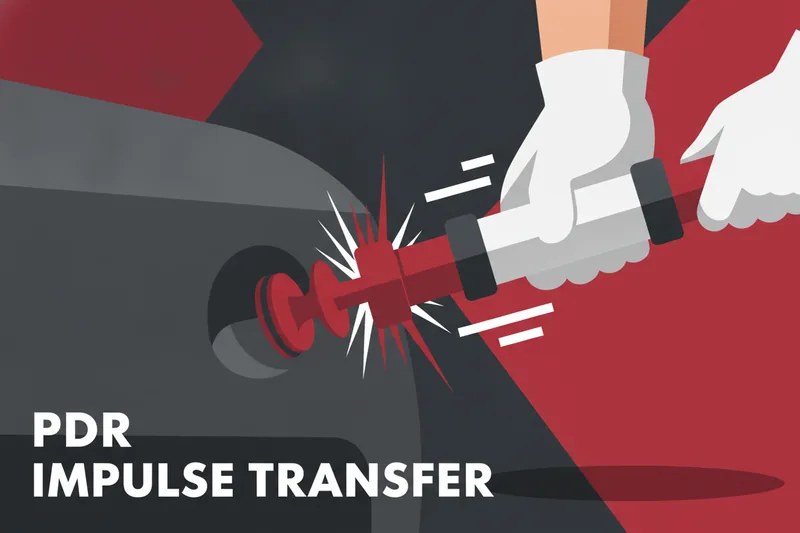
The mechanism is straightforward: a tab is bonded to the panel with glue, an adapter connects that tab to the hammer's shaft, and the technician racks the sliding weight back and drives it into the stop. Each strike sends a jolt of outward force through the tab and into the metal, gradually walking the dent back toward its original profile. This is why slide hammers pair almost exclusively with glue pulling rather than backside push tools — there's no access from behind the panel needed, which matters on double-skinned doors, sealed rails, and areas blocked by internal bracing. A complete glue-pulling kit typically bundles a glue gun, adhesives, a range of pulling tabs, and a lifter or slide hammer, precisely because none of those pieces does the job alone.
Types of PDR Slide Hammers: Standard, Spring-Loaded, and Auto-Return
Slide hammers used in glue pulling generally fall into three mechanical categories. A standard slide hammer is the simplest: you rack the weight back by hand and drive it forward into the stop, and the force of the pull is entirely down to how hard you cock and release it — full manual control, at the cost of consistency between pulls. A spring-loaded slide hammer adds a spring that assists the return stroke, cutting down on wrist fatigue during high-volume hail jobs where the same motion repeats hundreds of times a shift. An auto return slide hammer resets the weight to the strike position after each pull automatically, so a technician can fire repeated impulses without manually resetting the slide each time — useful when working through a dense hail field where speed matters more than single-pull finesse. Whichever type you run, the tab, adhesive, and technique underneath it still determine whether the pull comes out clean.
Choosing the Right Weight for Your Repair
Weight is the second variable, and it should be matched to the job rather than picked out of habit. Slide hammers used in PDR are commonly available across a range of weights, and the category isn't tied to one damage size — smaller, lighter variants are documented for more precise pulls, while the category as a whole covers hail and roughing work too. Lighter heads suit precise pulls on shallow, small dents where too much impulse risks overcorrecting or stretching the metal further. Heavier 3lb steel heads deliver more force per strike, which suits larger hail pitting, ridges, and bodylines that need more energy to move. Panel thickness and construction change the math further — a double-skinned door resists movement differently than a single-skin hood or fender — so weight choice should follow that resistance rather than a fixed rule of thumb. Selecting the pulling device before assessing the damage, finish, and access is one of the most common errors in PDR tool selection; weight comes after that assessment, not before it.
Slide Hammer + Cold Glue Tab Compatibility
A slide hammer only pulls as well as the tab and glue underneath it. Glexo's cold glue tabs are sized and shaped for different repair types — general panel work, hail kits, and micro kits for small dings — and each tab has to seat flush against the panel before the hammer applies force, or the pull transfers unevenly across the bonded area. Temperature affects glue performance, not the hammer: cold glue is a reusable, tacky or viscoelastic pulling compound, and using it outside the ambient range it's suited for is a common reason cold glue underperforms regardless of how capable the slide hammer is. Cold glue pulling relies on that same compound staying usable on the tab between pulls as long as it's kept in good condition — which is exactly why matching glue to temperature, not just tab to dent, keeps a hail-repair bay running through a full shift without constant adhesive swaps.
Slide Hammer vs Other PDR Pulling Methods
Glue pulling with a slide hammer is one branch of PDR, not the only one, and knowing where it fits prevents reaching for the wrong tool. Exterior pulling — the direction a slide hammer works in — is one of PDR's two mechanical directions, with hot-melt and cold-glue attachment serving as the two ways to connect to it; neither method is established as the industry standard over the other, and there's no fixed rule that cold glue always precedes hot glue on a job. Where a slide hammer pulls from outside the panel, sonic tips — a Glexo product line named for their spiked, rounded head shape, not an acoustic or powered tool — work from behind the panel, tapping stretched metal back into shape by hand for internal access dents. Knockdown tappers and blending hammers cover a different stage entirely: once the bulk of a dent has moved, these settle high spots and blend the metal after a pull rather than creating the pull itself. The slide hammer does the heavy lifting; tappers, sonic tips, and blending hammers finish what it started.
Best Practices for Glue Pulling and Avoiding Pushmarks
The biggest risk in glue pulling isn't a weak pull — it's an uneven one. Pushmarks are small dimples or high spots left behind when a tab releases unevenly or the panel wasn't properly supported during the pull. Light-shift refers to the way a repaired panel reflects light differently from the surrounding metal even without a visible mark, usually from residual stress left in the metal. Both are largely preventable at the prep stage. Surface contamination — wax, sealant, or old protective coatings — weakens tab adhesion and makes uneven releases more likely, which is why a deep clean with SPS surface-prep wipes before glue application matters as much as glue selection itself. Once the panel is clean and a temperature-appropriate glue is applied, the pull should be smooth and steady rather than jerked, and the tab should come off only once the compound has fully released its grip — rushing that step is a frequent source of both pushmarks and light-shift on hail jobs run at volume.
Buying Guide: What to Look for in a PDR Slide Hammer
Compare hammers against a short checklist instead of price alone:
- Tab compatibility — confirm the hammer's neck or adapter matches the tab sizes and shapes you already stock, particularly for a dedicated hail kit.
- Weight options — a shop doing mixed work benefits from stocking both 2lb and 3lb steel heads rather than committing to one.
- Kit contents — a complete dent puller kit should include the hammer, a set of tabs in common shapes, and enough glue to run a first job without placing a separate order.
- Build quality — the shaft and stop should hold up to repeated impact without developing play; a loose joint transfers less force into the pull and more into vibration.
- Warranty — a maker willing to stand behind daily shop-level use signals the tool was built for that workload, not occasional use.
A hammer chosen without matching tabs and glue is only half a decision — the three have to be selected together to hold up on a full day of hail or panel work.
FAQ
What does a slide hammer do? In PDR, it delivers a short, high-force impulse into a bonded glue tab, pulling the panel outward toward its original shape rather than pushing from behind.
Who makes the best slide hammer? There's no single "best" — a hammer's value depends on how well it matches the tabs, glue, and workload it's paired with, plus its build quality and warranty. A well-built hammer with the wrong tab system will still leave a poor pull.
What is the strongest PDR glue? Strength isn't a single fixed spec for PDR glue — cold glue and hot-melt adhesive are different attachment methods with different roles, and cold glue itself is selected by ambient temperature range rather than by a single "strongest" rating.
Ready to match a slide hammer to your actual workload? Browse Glexo's PDR slide hammers and matching cold-glue tab kits, and ask about volume discounts for regular shop orders.