PDR Hail Dent Repair Kit: Professional Cold-Glue Systems
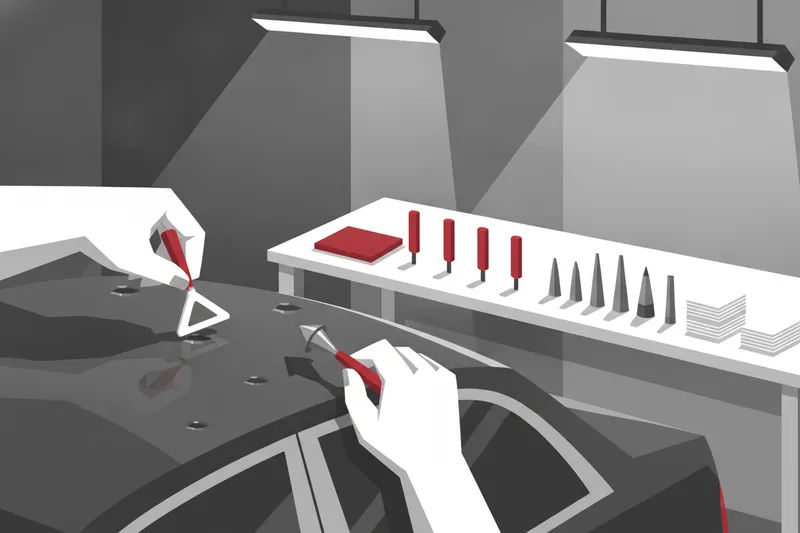
A professional PDR hail dent repair kit centers on a cold-glue tab system matched to panel temperature, internal-access tips sized to the damage you're reaching, knockdown tools for finishing, and surface prep that guarantees the glue bonds before a pull ever starts. These are the core components that separate a repeatable, professional setup from a one-size kit — not the only methods a shop will ever reach for, since some damage still calls for hail rods or other specialized pulling approaches. What makes a kit "professional-grade" isn't the box it ships in — it's whether each piece is chosen for the metal, the access, and the temperature on the panel in front of you, instead of being a fixed slide-hammer-and-suction-cup bundle sold as one universal hail dent repair kit.
What a Hail Dent Repair Kit Is Built To Do
A hail-damaged vehicle isn't one dent repeated a hundred times. It's a portfolio of damage that varies simultaneously in panel construction, material, dent count, depth, sharpness, body-line location, and coating condition — sometimes with implications for glass, trim, or electronics nearby. A kit that only does one thing well doesn't survive contact with that variation.
Core components of a working kit
A functioning hail kit brings four core functions together on the bench, alongside whatever other methods a shop layers in for damage these don't reach:
- A glue-based pulling system — cold glue, tabs, and a pulling device — for pulling metal where there's no useful access from behind the panel.
- Internal-access tips, for working suspected stretched metal directly where panel access exists, reaching through an opening to reset the metal from behind.
- Knockdown tools, which settle the small remaining highs that pulling alone doesn't fully close out during finishing.
- Surface prep supplies, which remove whatever is sitting between the paint and the glue before a tab ever goes down.
Any single accessory system is one tool inside that plan, not the plan itself. A hail kit is judged by whether these functions are covered with enough depth to keep working through a full panel, not by how many pieces are in the case.
The Principles That Separate Professional Kits From Generic Puller Kits
Generic dent-puller kits sold on marketplaces are usually built around one pulling approach — most often a suction cup or a single glue-pull bridge — rather than the mix of approaches hail damage actually needs. Judge any kit against four criteria: adhesion reliability, metal control, pushmark risk, and redundancy for volume work.
Why generic slide-hammer kits fail on real hail damage
Pulling devices in PDR aren't interchangeable. Each one answers a different kind of pull:
- A mini lifter — a small handheld lever tool — gives a controlled, localized point pull.
- A bridge or beam puller — a frame that spans the dent and anchors the tab — sustains a pull with support around the repair.
- A slide hammer delivers a fast impulse pull through a sliding weight.
- A T-handle puller applies a direct manual pull by hand.
A kit built around one pulling device, usually the slide hammer, has no answer when a dent calls for a sustained pull instead of an impulse one — the technician either forces the wrong technique onto the dent or stops. On a hail roof, that limitation shows up fast: the shallow, uniform dents across the design crown of the roof often respond better to a sustained bridge pull, while the sharper dents near a body line need the quick, localized pull a mini lifter or slide hammer gives — a one-device kit can't answer both.
Cold-glue pulling itself is one method among several conditional approaches — sustained bridge and beam pulling, lateral tension work, metal settling for broad, shallow areas — each suited to a different kind of damage, not a hierarchy where one dominates. A kit that can't shift between them runs out of options on a panel with mixed dent types, which is exactly what a hail roof is. That mismatch is also where pushmarks come from: forcing an impulse pull or an oversized tip onto a dent that needed a slower, sustained approach leaves a local high or a texture mark where the tool contacted the panel. Redundancy — extra tabs, spare tips, a second pulling device — isn't a convenience feature on a high-volume hail job; it's what keeps the line moving when one tab fails to release cleanly or one tip is the wrong size for the next dent.
Matching Glue, Tips, and Prep to Your Working Conditions
The same component list performs differently depending on temperature, access, and what's on the paint. This is where kit choice stops being generic and starts being a judgment call.
Temperature and glue tack
Glue tack — how aggressively the adhesive grabs the tab and panel — shifts as the glue and panel warm up. Cold glue is formulated to work across a wide ambient range, roughly -15°C to 30°C (5°F to 86°F), holding tack within that window long enough to set without running. Outside that range, or on a panel sitting in direct sun well above ambient temperature, tack behavior stops being predictable — the tab grabs too fast, releases too soon, or won't set cleanly. If the pull's behavior stops matching what's expected for the glue and the conditions it's rated for, that's a stop signal, not something to push through: check the panel surface temperature, not just the air, before troubleshooting the tab or the technique.
Tip and hammer selection by panel access
Where there's internal access, internal-access tips do the direct work: a softer, rounded tip spreads contact over a broader area for gentler settling, while a sharper tip concentrates force for precise work on tighter, sharper dents — though a soft tip distributes action without eliminating the risk of overpush if it's handled carelessly. Blending hammers follow the same logic: lighter hammers suit fine detail work where small, controlled taps matter most, while heavier hammers move more metal per strike on broader, shallower damage. Weight is a real selection criterion, not a cosmetic one — the wrong weight either undersettles a high or overdrives it into a new low.
Why surface prep affects adhesion
Wax, ceramic coatings, liquid glass treatments, and road film all act as a separator between paint and glue, and they're exactly what shows up on hail-damaged vehicles that have sat outside. Surface prep — cleaning with isopropyl alcohol, a PDR-specific degreaser, or a surface-prep wipe built for ultra-deep cleaning before glue goes down — removes that layer before a tab ever touches the panel. A working glue-pull setup depends on checking a few pairings before the job starts: that the cleaner won't haze the finish, that the adhesive suits the tab material, and that the tab interface matches the pulling device going on it. On refinished panels, filler repairs, ceramic coatings, or PPF and wrap, run a quick adhesion test on a small, hidden spot first — those surfaces don't always bond the way bare factory paint does, and a failed tab mid-pull costs more time than the test does.
Building Your Kit: What to Choose by Category
Selecting tools for a kit comes down to matching categories to the conditions a shop actually sees, not stocking whatever happens to be bundled together. Four things drive the decision: the panel and substrate the shop works on most, the finish condition it needs to protect, the access and damage mechanics of the dents it sees, and the volume it has to sustain through a full hail job. Built against those criteria, a kit breaks into four categories:
- Glue-tab system: cold glue, a range of tab shapes and sizes, and a pulling device matched to the tab interface — chosen by panel access and finish, not by what's cheapest to bundle.
- Internal-access tips: a soft and a sharp option at minimum, sized for the access points the panel actually offers.
- Knockdown tools: sized and tipped for fine finishing work after the bulk of the damage is pulled.
- Surface-prep supplies: a cleaner or surface-prep wipe, and where the finish calls for it, an adhesion promoter and a release product — distinct jobs, even when one product covers more than one of them.
Not every category gets used on every single dent, but all four need to be stocked before a hail job starts — running out of one mid-panel stops the line, not just that repair.
Glexo builds its PDR tools and consumables — glue-based pulling systems, specialty tips, knockdown tools, and surface-prep supplies — for shops running this kind of volume. Explore Glexo's professional hail-repair tool and consumable range to build a kit suited to your shop's volume and working conditions.