Paintless Dent Removal Kit Guide for Pros
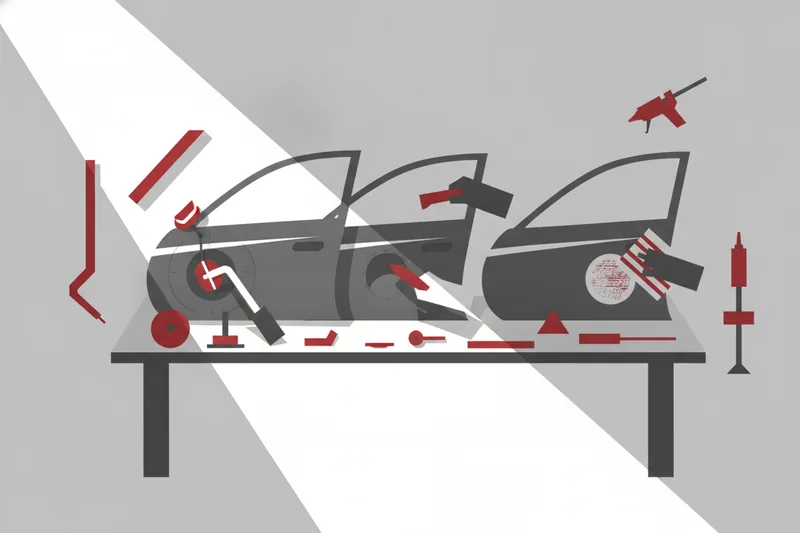
A paintless dent removal kit is the working set of tools and consumables a technician uses to restore a panel's shape without disturbing the factory or refinished paint — not one gadget, but a system built around three jobs: pulling metal back into place, pushing it from behind where access allows, and prepping the surface so the pull actually holds. Paintless Dent Repair (PDR), the preferred name for this work in the US market, covers the group of professional methods that restore a qualifying panel's shape through controlled metal movement while keeping the existing finish intact. A real kit therefore combines four roles — a glue system that grips the dent center, tabs that transfer pulling force, a device that applies that force, and access tools that reach the panel's backside — and it gets used on hoods, roofs, doors and fenders where paint condition and backside access, not preference, decide which combination applies.
Many marketplace listings build the whole idea of a "dent kit" around a rubber suction cup. In professional shops that tool is a narrow option for large, shallow dings on flat panels, not for sharp creases or cracked paint, and it rarely shows up as a working technician's primary tool at all.
How Paintless Dent Removal Actually Works
Glue-pull technique: tabs, glue and tension
The glue-pull method bonds a tab to the center of the dent, using either cold glue — a reusable tacky or viscoelastic compound — or PDR hot-melt adhesive, a consumable applied to the tab with a glue gun and set as it cools. Once the tab is seated, the technician attaches a pulling device: a slide hammer for a direct, inertial pull on a single tab, or a bridge puller, which spans the repair zone so several tabs can share the tension for a slower, more controlled lift. "Paintless" describes this outcome and repair path, not the absence of every material — cleaning agents, release products and the glue itself are all part of a paintless job. What actually moves the work outside paintless territory is a different category of operation: self-tapping screws, welded studs, or sanding the panel.
Tap-down technique: access tools and controlled metal movement
Where the panel's backside is reachable, technicians work from behind instead of, or alongside, pulling from the front. A knockdown tapper — also just called a tapper — delivers small, controlled strikes to lower a high spot created by the pull, while a blending hammer settles the surrounding metal so the repair blends into the panel rather than leaving a visible ring. For tight interior cavities — rocker panels, door skins, roof rails — Glexo's Sonic tips give a reach tool with soft, rounded heads for gentle sustained pressure, or sharp, spiked heads for short, precise strikes, reaching spaces a hammer can't enter. Most jobs use both methods: pulling creates the gross movement, tap-down and blending finish the surface so it reads as undamaged.
What's Included in a Professional-Grade Kit
Glue and tab components
A shop-grade system carries cold glue in more than one temperature grade, because tack and set time shift with ambient heat — a glue mixed for a cool morning can run soft and slip on a hot afternoon, and the reverse holds just as true. Hot glue sticks cover jobs where a faster, firmer bond matters more than reusability. Tabs need real range too: small rounds and micro tabs for hail pitting, crease and mid-size tabs for door dings and linear creases, and larger tabs for broad, shallow damage — with enough of each on hand to keep working through a multi-vehicle job without stopping to clean and reuse the same handful.
Metalworking and access tools
Pulling only roughs the panel out; the tapper and blending hammer finish it. Tappers come with interchangeable tip sizes so contact area can match the size of the high spot, and blending hammers are sold in multiple weights so the impact scales from light finishing taps to firmer movement on stiffer panels. Pulling hardware itself varies the same way — slide hammers of different mass, T-handle pullers for direct hand-operated pulls on a single tab, and bridge pullers for multi-tab jobs — so a kit needs more than one type to match force to tab size and panel stiffness. Sonic tips round out backside access with soft heads for sustained pressure and sharp heads for short, targeted strikes where nothing else fits.
Surface prep and consumables
None of the above holds without clean paint underneath it. Surface-prep wipes do a deeper clean than a rag and solvent, lifting wax, sealant and coating residue that would otherwise sit between the glue and the paint and weaken the bond. Anti-adhesive film protects tabs between jobs so they go back into the kit ready to reuse rather than tacky with old residue. No tool category here has a documented industry-standard share of use — the mix that matters is the one that matches the vehicles and damage actually coming through the shop door.
DIY vs Professional PDR Kits: What Actually Separates Them
Marketplace kits built for home use typically rely on one of a few basic approaches — a suction puller, a glue-pull kit, or a rod kit — each pitched as a complete answer for any dent. In professional use, a suction-style puller stays a narrow option for large, shallow dings on flat panels, never the primary tool of a working technician, and a single cold-glue formula can't cover a shop's range of ambient temperatures, panel materials and damage types.
Temperature match isn't cosmetic. A glue mixed for mild weather left on a hot panel can soften past its working tack and let the tab slip mid-pull, costing the job and risking the panel. The same logic applies to prep: older paint, ceramic coatings and factory wax layers all sit between the tab and the metal, and skipping a real degreasing step is one of the most common reasons a bond fails on a job that otherwise looked straightforward.
Hail season exposes the other gap. A shop clearing a lot of vehicles in a week needs redundant tabs in the sizes it actually uses, so a technician isn't stopping mid-panel to clean and re-glue the same three tabs; a consumer kit with one tab per size was never built for that pace.
It's also worth being clear about what a kit doesn't settle on its own. Whether a dent is a good PDR candidate depends on its depth, the metal's stretch, its position relative to bodylines and edges, the finish's condition and history, and the access behind it — not the dent's size alone — and a panel that's already been refinished carries extra adhesion risk that calls for a compatibility check before any tab goes on. Mobile and on-site repair work runs under the same rules as shop repair; it isn't a shortcut with lower standards.
How to Choose the Right Kit for Your Shop
Choosing a kit starts with the jobs it needs to cover, not the other way around — the tools on hand shouldn't dictate the diagnosis. A practical order to work through it:
- identify the panel, material, finish and any OEM restriction first
- confirm the access behind the damage and the repair target
- decide which method the job calls for
- only then select the tool and contact point that fits
For a general body shop, that typically means cold glue in at least two temperature grades so summer and winter jobs both get a reliable bond, a tab assortment spanning micro to standard sizes, a tapper with a couple of interchangeable tips, and one or two blending hammer weights. A dedicated hail operation needs the same categories scaled up — more tabs per size, since a crew works through dozens of dents per panel without pausing to clean and reuse the same three.
Glexo builds its cold-glue systems, tabs, tappers, sonic tips and surface-prep wipes around this same logic: temperature-matched glue variants, tab sets sized for general, hail and micro work, and access tools in a range of weights and tip shapes, so a shop can assemble a kit around its actual job mix instead of buying a fixed bundle built for nobody in particular.
Price Ranges and Where Shops Actually Buy
Consumer marketplace kits built around a suction cup and a basic glue-pull set typically sit in a low price band — often well under what a single professional pulling device costs on its own — which reflects the gap in what they're built for. A shop-grade system, assembled from cold glue, tab sets, a puller and tap-down tools, runs higher, and it isn't sold on the promise that it will always come out cheaper than sending the same panel through a conventional body shop; what it buys instead is control and repeatability on work a shop repeats every week.
Buying direct from a tool manufacturer rather than an open marketplace listing matters for a related reason: a given maker's range is usually narrow and specific — one brand focused on polishers and compounds, another on knockdowns, tips and cold-glue kits — so a generic "dent kit" assembled by a reseller says little about what's actually inside, and a brand shouldn't be judged by whatever one retailer happens to stock under its name.
Shops in Australia, New Zealand and other markets outside North America and Europe face the same sourcing question in a sharper form — most professional-grade PDR brands aren't carried on general marketplaces in those regions, which pushes buyers toward manufacturers that ship internationally and support recurring orders with volume pricing.
FAQ: Dent Removal Kits for Professionals
What does the best paintless dent repair kit look like for a professional? There's no single build that wins every job. The strongest kit is the one matched to a shop's actual mix of work — temperature-appropriate cold glue, a tab range deep enough for hail volume, and tap-down and blending tools sized to the panels coming through the door — assembled from proven categories rather than bought as one fixed bundle.
How should I read paintless dent repair kit reviews critically? Treat marketplace star ratings carefully: a seller's catalog reflects what that one brand happens to make, not the category as a whole — a maker known for knockdowns, tips and tabs isn't a reference point for a different brand's rods or hand tools — and a review praising a suction-cup kit as fast and easy usually says more about light, flat dents than about that tool's place in professional work.
Does one kit work for every panel and every dent? No. Larger or more complex dents typically call for a different combination — a bridge puller or broad push approach, glue chosen for the pull dynamics, and extra support and lighting to track progress — while hail-style damage needs its own assessment by panel, dent pattern and finish before it's even treated as a PDR job. A kit is a set of options matched to the work, not a one-size answer.
Browse Glexo's professional cold-glue systems, tabs, tappers and access tools, and ask about volume discounts for shops ordering regularly — worldwide shipping means a shop in Melbourne or Auckland can set up the same system a North American hail crew runs.