PDR Hot Glue vs. Cold Glue: When to Use Each
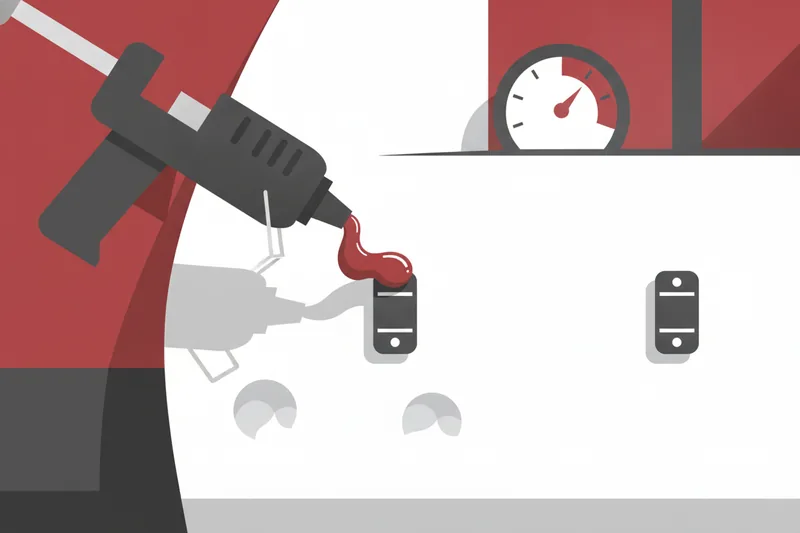
PDR hot glue — more precisely called PDR hot-melt adhesive — is a solid thermoplastic stick fed into a glue gun, heated past its melt point, and applied as a liquid bead onto a glue tab, the rigid or semi-rigid attachment bonded to the panel through which pulling force travels. The technician presses the tab onto the dent's high or low point while the melted adhesive flows into the texture of the clearcoat. The bond doesn't form at the moment of contact — it forms as that melted adhesive cools and re-solidifies, locking the tab to the paint. Cooling isn't instant: a fully melted stick still needs roughly 8 to 10 minutes to set enough to hold under load, a little faster in a cold bay. Exact tack strength, open time, and which tab materials bond best vary by stick formulation, so a combination that holds for one brand may behave differently with another. That's a separate question from gun wattage and voltage, which decide how fast you can reload between sticks rather than how the glue itself performs — and the pull technique that follows, once the tab is seated, is its own skill on top of all this.
Hot Glue vs. Cold Glue: Which Wins on Tack Time, Strength, and Temperature
Hot glue and cold glue aren't a stronger option and a weaker backup — each suits different damage, finish, and climate conditions. On tack time, hot-melt needs the melt-and-cool cycle above: full working strength takes several minutes to develop as the stick cools. Cold glue skips that cycle. It's a ready-to-use, tacky compound pressed straight onto a compatible tab, no gun and no cooling wait. That's why many hail crews run cold glue for fast initial pulls across large areas, then switch to hot glue for the deep, small, or sharp-edged dents where hot-melt's pinpoint pulling force does a job a reusable compound can't. On raw strength, properly set hot glue holds hard and can generate very high pulling force on stubborn damage — it's not a compromise adhesive. Cold glue's strength and stiffness, by contrast, are product-specific: the category isn't one standardized chemistry, so one shop's cold-glue system may pull noticeably differently from another's.
Temperature is where the two diverge most. Shop air still affects how fast a hot-melt bond sets and how the cured glue behaves — cold air shortens the window, warm air stretches it. Cold-glue systems are built around a stated working-temperature range, so the product that performs in a 50°F bay isn't the one you'd want above 86°F. Matching the glue to the room, rather than fighting it, is the whole point of a temperature-matched lineup.
Working Conditions That Change the Outcome: Prep, Cooling Time, and Hail Volume
Surface prep decides whether either adhesive holds, regardless of which one you pick. Wax, sealant, ceramic coating, and road film all act as a release layer between paint and glue. A panel that still carries that contamination won't even give you an accurate final dent count, because the count has to be taken on a clean, dry surface — not from pre-clean photos. A quick wipe with isopropyl alcohol or a PDR-specific degreaser before each pull isn't optional on older paint or anything coated; it's the difference between a tab letting go mid-pull and one that holds. If adhesion keeps failing after that wipe-down, the problem is usually the tab or the stick combination, not the wipe itself.
Cooling time is the variable technicians most often underestimate. A hot-melt stick that looks solid on the tab may still need 8 to 10 minutes to fully set before it can be loaded, slightly less in a cold shop. Rushing that window is a common reason a pull slips.
On a hail job, that wait compounds across dozens or hundreds of dents, which is why high-volume crews rarely run on one adhesive alone. Documented hail workflows mix reading lights, rods, whale tails, hot-glue tabs and pulling devices, knockdowns, and cold glue — whichever tool fits each dent, rather than one method forced across the whole panel. The real limit on that pace is overstretching a panel past the point where it holds its shape, known on the floor as a flapper; working fast still means working inside the metal's limit, not just swapping tabs quicker.
Deciding Between Hot Glue and a Temperature-Matched Cold-Glue System
There's no mandatory order that says cold glue always goes first or hot glue always finishes a job — the repair plan decides, dent by dent. Hot glue remains a current, valid method, not a legacy step cold glue made obsolete. Reach for hot glue when you need maximum pulling force on a deep, small, or sharp-edged dent, when the shop is cool enough that the cooling wait won't slow you down, and when you're running single or low-volume pulls. Reach for cold glue when you're running continuous pulls across a panel or a hail job, when ambient temperature swings through the day, or when you want a compound that comes off the tab and goes back on without melting a new stick each time, no gun required.
Because cold glue's tack and stiffness shift with temperature, the deciding factor for most shops isn't hot-versus-cold in the abstract — it's which cold-glue formulation matches today's bay temperature. Compare your shop's working-temperature range and job mix against that, and it's worth looking at Glexo's cold-glue system lineup, built around ambient working range rather than one all-weather compound, so you pick the variant suited to conditions instead of expecting one compound to perform the same at 60°F and above 86°F — cold glue's behavior depends on matching it to temperature, keeping the panel clean, and proper storage.
If your bay runs cool and most of your work is single or low-volume pulls, Glexo's hot melt glue sticks fit that pattern, since the cooling window you need is shortest when ambient temperature is already on your side. For hail-style volume or a bay that swings through the day, the cold glue variants built for different temperature ranges let you match the compound to that day's conditions instead of forcing one formulation across every job. And since neither adhesive holds on a contaminated panel, keeping SPS surface-preparation wipes at the bench makes that wipe-down step part of the pull routine rather than an extra trip for a rag.