Best PDR Glue for Hail Repair | Glexo

Choosing the "best" PDR glue for hail repair isn't about picking a single winner off a shelf — it's about matching adhesive chemistry to the day's temperature, the panel's material, and how many dents you need to pull before the sun goes down. For high-volume hail work, that means treating glue, tabs, and pulling tools as one system rather than three separate purchases, and picking a temperature-rated formula that behaves predictably whether you're working a lot in July heat or a January storm chase.
What Is PDR Glue (Glue Pull Repair) and How It Works
Glue Pull Repair (GPR) is a cold-straightening technique, closely related to conventional paintless dent repair, that uses an adhesive attachment to transfer pulling force into a panel without welding on studs and without removing the coating just to create that attachment point. In plain terms: instead of pushing a dent out from behind the panel with a rod, the technician bonds a glue tab — an exterior attachment through which pull is transferred — to the dent's surface and pulls outward.
PDR glue is what makes that bond temporary but strong enough to move metal. A pulling device, usually a slide hammer or mini lifter, connects to the tab and applies smooth, steady outward force until the metal returns toward its original shape. This pull-based approach exists because plenty of hail damage sits on double-skinned panels, sealed structural sections like cant rails, or areas blocked by internal bracing where a technician physically cannot get a rod behind the dent. Glexo builds its cold-glue systems and tab kits around exactly this workflow, since hail claims are where GPR gets used at real volume rather than as an occasional trick. A typical glue-pulling kit — glue or glue gun, adhesive, an assortment of tabs, and a lifter or slide hammer — exists specifically to handle that inaccessible-panel problem at scale. It's worth noting GPR is a specific term, not a catch-all: it doesn't automatically mean the result is paintless, and it isn't synonymous with every instance of glue pulling in PDR.
Cold Glue vs Hot Glue: Which One Wins for Hail Damage
The two adhesive families work differently, and the difference matters most when you're pulling dozens of dents per panel.
Cold glue is a ready-to-use, tacky/viscoelastic compound applied directly to a tab — no heat gun required. It's not a two-part or structural adhesive; it's a reusable pulling compound whose reuse depends on staying clean and within the product's condition limits. Hot glue, by contrast, is a PDR hot-melt adhesive melted with a glue gun that temporarily bonds a tab to the finish, with load transferred through a defined chain: pulling device → adapter/neck → glue tab → adhesive → finish → panel skin.
For hail work, the practical trade-off comes down to cycle time. Cold glue's compound peels cleanly off after a pull and goes right back onto the next tab, with no cooling or reheating step — a real advantage when a single panel might carry twenty or more dents. Hot glue needs to melt, bond, and set before each pull, then be cleaned off after, which slows throughput on multi-dent panels but delivers rock-solid adhesion and strong pulling force on stubborn, deep, or very small dents that cold glue's softer tack can struggle to grip precisely. There's no industry-mandated order between the two — plenty of shops run cold glue first for broad movement and switch to hot glue for the leftover deep low spots, but that sequence isn't universal or required. For pure hail volume, most shops lean cold glue for the bulk of the panel and keep hot glue in reserve for the deep survivors.
How Ambient Temperature Affects Glue Choice
Adhesives are temperature-sensitive by nature — stability drops as things get hotter, which is a known limitation of adhesive bonding generally. That's the reason temperature-rated glue exists: formulas built for use up to roughly 86°F/30°C behave differently in tack and set speed than formulas meant for use above that threshold. Below the rated range, cold glue can feel stiff and slow to grip; above it, the same compound can go soft, lose tack, or pull unevenly.
A few things trip up technicians who haven't standardized their temperature workflow:
- A glue gun's dial setting is not the same as the panel's actual surface temperature or the temperature at the bond line itself — the two can diverge significantly on a hot hood or a cold aluminum roof.
- Warming a glue system into working condition is not permission to heat the panel itself; conditioning the adhesive and heating the substrate are two different actions with different risk profiles.
- Glue-stick color and a competitor's gun-temperature number aren't transferable between brands — they're not an industry classification system.
- Cold glue's pull behavior shifts with tab area and shape, compound thickness, product/panel/ambient temperature, cleanliness, contact duration, pull rate, pull direction, and how many cycles the compound has already been through.
Practically, this means matching your glue variant to the job-site conditions of the day — not just grabbing whatever tub is open in the van. If tack time stretches out, adhesion feels unpredictable, or the panel develops secondary marking during a pull, that's the signal to stop and reassess rather than force it — a mismatch between glue behavior and ambient conditions is exactly what causes failed pulls and pushmarks.
Best PDR Glues for Hail Damage Compared
Two names come up constantly in hail-repair forums: Brazilian Gold PDR glue and Mega Power Hero Blue glue. Both are hot glue sticks — sold as stick packs (commonly around a 1 kg pack of roughly 30–31 sticks, 30 cm long) rather than tub-based cold-glue compounds — built for the melt-and-bond exterior pulling described above, not the ready-to-use cold-pull workflow that drives volume on a hail panel. That distinction matters more than brand reputation: a hot-glue stick, however well regarded, still carries the melt-cool-clean cycle on every tab, while cold glue skips straight to the next pull.
That's the gap Glexo's cold glue system is built to close for hail crews — separate formulas rated for up to 86°F/30°C and above 86°F/30°C, so a shop chasing storms across regions and seasons isn't stuck reheating a glue gun between every tab just to keep pace. Adhesion strength and cost per repair both hinge on getting that temperature match right; a cold-glue variant that grips well in the morning but softens by mid-afternoon costs more in redo time than any price difference between products — while a hot-glue stick like the two above still earns its place on the deep, sharp holdouts a panel leaves behind, just not for the bulk of the volume work.
One caveat that applies regardless of glue type: a previously refinished panel isn't automatically off-limits for PDR, but it carries a higher and less predictable risk of coating cracking, lifting, or delamination during a glue pull, so adhesion behavior there needs a product-specific check and an informed call before you commit a tab to it.
Aluminum vs steel panels: does it change your glue pick?
Aluminum panels are explicitly among the situations glue-pulling systems are suited for, particularly where conventional rod access is limited. Beyond that, panel material interacts with tab stiffness, contact area, and pull force in ways that are project-specific rather than governed by a fixed rule — there isn't a documented universal "use this glue on aluminum, that glue on steel" chart. The safer approach is to treat aluminum as requiring more conservative pull rates and tab sizing, and to confirm your specific glue and tab combination is rated for the panel you're on rather than assuming steel-proven settings transfer directly.
Best Tabs and Kits to Pair with Your Glue
A glue tab isn't a suction cup — it doesn't generate pulling force on its own; it's a temporary exterior contact point that transfers load from your pulling tool into the panel. Every tab has four functional parts: a contact face where the adhesive sits, a body that sets its stiffness or flexibility, a neck or load path, and an interface for the adapter or puller. Reaper/dead-center tabs and similar hail-kit tabs are built around this same anatomy, sized and shaped for the dense, small-diameter dents typical of hail damage.
Tab choice for hot-glue work in particular needs to account for the shape and scale of the low spot, panel curvature, the direction load needs to travel, tab stiffness, and compatibility with your neck/adapter/puller and the panel material itself. Before any pull, six compatibility pairs need to check out: finish with cleaner/release product, adhesive with glue gun, adhesive with tab, tab with panel, tab neck with adapter, and adapter with puller. Skipping that check is a common reason pulls fail or slip.
Surface texture, color, or smoothness on a tab is not a universal strength rating — don't assume a rougher-looking tab is automatically stronger. And cold glue doesn't require a dedicated "cold-glue gun" as some marketing implies; it's typically applied straight onto a compatible tab. For a slide hammer or mini lifter setup, redundancy matters more in hail work than in single-dent jobs — running out of a matched tab size mid-panel on a high-volume day is a real throughput killer, so hail kits are usually stocked with multiples of the common sizes rather than one of each.
Step-by-Step Glue Pull Repair Process for Hail Dents
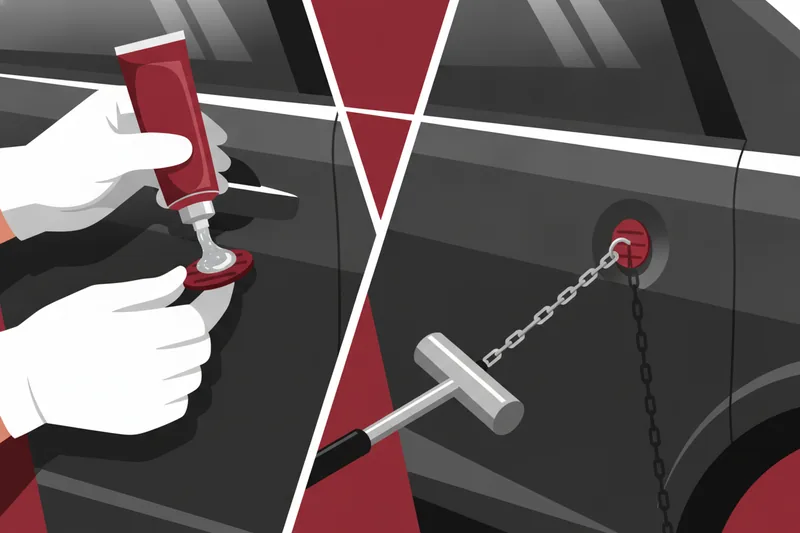
A hail-damaged vehicle isn't one dent repeated dozens of times — it's a portfolio of variation in panel material, dent count, depth, sharpness, body-line proximity, and coating condition, all on the same car. The workflow below holds across that variation, but each step needs judgment calls specific to the panel in front of you.
- Clean the panel thoroughly. Surface contamination is the most common reason adhesion fails. Disposable wet wipes designed for deep PDR surface prep — Glexo's SPS wipes are built for this — cut through the wax, sealants, and protective coatings that block a tab from bonding properly, which matters even more on older paint or coated finishes.
- Protect surrounding areas if needed. An anti-adhesive film can shield finish you don't want the glue to touch during a dense multi-tab session.
- Select and place the tab. Center it on the dent, matching tab size and stiffness to the dent's diameter and depth.
- Apply the glue — cold glue pressed onto the tab face, or hot glue melted and bonded per the product's working temperature.
- Pull. Attach the slide hammer or mini lifter and apply smooth, steady outward force rather than sharp jerks; glue-pulling works from the outside of the panel, not by pushing rods from behind.
- Reassess after each pull. Check for over-pull, high spots, or coating stress before moving to the next dent.
- Remove tab and residue. Peel cleanly and wipe any remaining compound before the next application.
Be cautious near body lines: some small dents sitting right on a body line respond poorly to glue pulling and may need a different method — that's a method-selection call, not a reason to avoid glue pulling generally.
Cost of Hail Damage PDR Repair
Hail-repair pricing isn't a flat per-dent rate; it's built from several factors layered together. A technically doable repair can still be economically irrational if access, removal-and-installation labor, finish risk, or time required pushes past what's efficient for that panel. Repairability itself depends on the panel, damage group, finish condition, access, and any OEM restrictions on cold-straightening that panel — not every dent that looks PDR-friendly actually qualifies. A complete quote realistically needs vehicle and panel identity, damage inventory (type, count, size, geometry), material and finish condition, access notes, any required glass/scanning/calibration work, and consumables cost, among other line items. A proper hail estimate should also be built from a clean vehicle assessed indoors under dedicated PDR lighting — not a quick look in a parking lot.
This is where glue reliability quietly affects the bottom line. Every failed pull that leaves a pushmark, or every tab that lets go mid-pull because of a temperature mismatch, adds redo time that eats straight into that day's dent count — and on hail volume, dent count is the whole economic model. PDR itself is a broad set of methods for restoring panel shape while keeping the existing finish intact, and hail damage remains one of its most common applications, alongside door dings and minor collision work. Technicians who specialize in hail seasons can see substantial swings in income during active storm periods, precisely because throughput reliability compounds across hundreds of dents.
FAQ
Which glue is best for hail damage? There's no single best glue — the right choice is a cold-glue system rated for the day's temperature, paired with tabs sized for hail-density dents. Cold glue generally wins on throughput for the bulk of a hail panel; hot glue sticks earn their place on the deep, sharp holdouts.
Cold glue vs hot glue for beginners — which is easier to start with? Cold glue has a shorter learning curve for volume work since it skips the heat-and-cool cycle and doesn't require a heat gun. Hot glue takes more practice to judge bond strength and timing but rewards that practice with more pulling force on tough spots.
How should PDR glue be stored? Cold glue's reusability and pull performance depend on staying clean and kept within the temperature and condition limits stated by the manufacturer — heat exposure, contamination, and repeated cycles all degrade it over time. Keep it covered, out of direct heat, and away from dust between jobs.
Can one glue work in all temperatures? Not reliably. Because tack and set behavior shift with ambient and panel temperature, and because adhesives generally lose stability as temperatures climb, a single formula struggles to perform consistently across a cold morning and a hot afternoon. That's the reasoning behind temperature-rated variants rather than one all-purpose glue.
If your shop is choosing between adhesive systems for the next hail season, compare Glexo's temperature-matched cold glue systems and hail-repair tab kits side by side, and ask about volume discounts for regular shop customers before storm season hits.