Hot Melt Adhesive for PDR: When to Use It
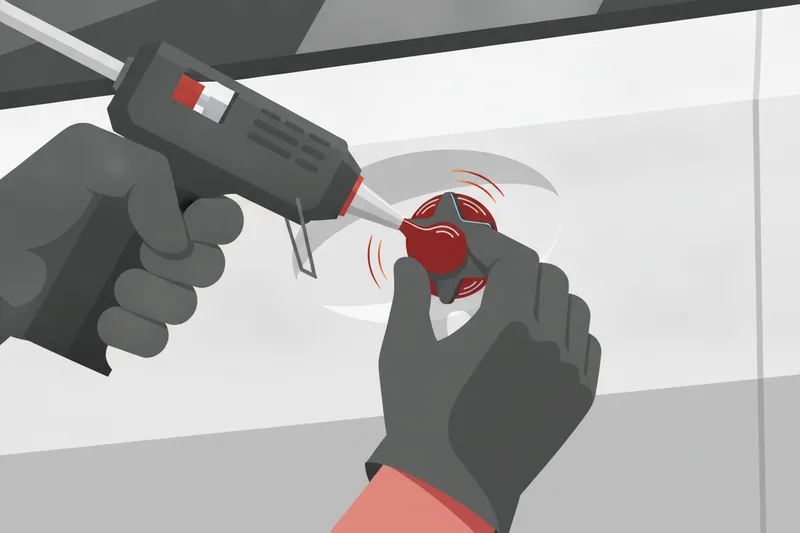
Hot melt adhesive is a thermoplastic polymer that turns liquid when heated and forms a solid, load-bearing bond as it cools. In a PDR (paintless dent repair) shop, that compound is loaded into a glue gun, melted onto a pulling tab, and stuck directly to the panel's exterior finish for the pull. Whether it beats a cold-glue tab system on a given dent depends on backside access, panel temperature and how much control the pull needs — not on brand loyalty. Glexo builds PDR-grade hot melt glue sticks alongside its cold-glue systems for exactly this reason: most working technicians carry both and choose the one that fits the job in front of them.
What Is Hot Melt Adhesive?
Hot melt adhesive (HMA) is a solvent-free thermoplastic polymer — a plastic-based compound that stays solid at room temperature and liquefies when heated, with no chemical cure involved. The base resin in most formulations is EVA (ethylene-vinyl acetate), a flexible copolymer chosen for its balance of flexibility, gap-filling body and adhesion to varied surfaces.
The compound is applied with a glue gun / applicator — a handheld tool that heats the adhesive past its melting/softening temperature until it flows, then dispenses it as a bead or dot. As the adhesive cools below that softening point, it re-solidifies and develops its working bond strength — the force the cooled joint can resist before it releases or fails. That heat-liquefy, cool-solidify cycle is what separates hot melt from adhesives that cure chemically.
How Hot Melt Adhesive Works: Chemistry & Application
There's no curing reaction here — hot melt bonds through a physical phase change. The glue gun / applicator heats the solid stick above its melting/softening temperature until it becomes a viscous liquid; that liquid is applied to the substrate while it's still hot and flowable, then pressed against the second surface (in PDR, a metal glue tab) before it has time to skin over.
From there the joint enters a cooling/setting cycle: as the adhesive drops back below its softening point, it thickens and locks the tab to the panel, developing bond strength as it goes. Bond formation is complete once the adhesive has fully hardened — pulling before that point risks a partial bond and a failed grip. Because the whole cycle is thermal rather than chemical, it's reversible: reheating the same adhesive breaks the bond down again, which is part of why removal after a pull is a heat-and-peel process rather than a solvent one.
Types and Formats of Hot Melt Adhesive
Sticks vs. pellets/chips vs. film
Hot melt adhesive is sold in several physical formats built for different dispensing equipment: pellets and chips feed bulk industrial glue guns and hopper-fed systems, sticks feed handheld trigger guns (the format used in PDR and most trade work), and film is a thin, pre-cut sheet used where a flat, even adhesive layer matters more than a bead.
PDR glue sticks are a purpose-built subset of the stick format, formulated for bonding a metal tab to an exterior automotive finish rather than for general fabrication. Some hot melt lines now use bio-based adhesives — formulations that substitute some or all of the polymer feedstock with renewable sources — though performance still depends on the specific product rather than the feedstock alone. Format choice in PDR also intersects with access: for double-panel sections or spots with no usable backside access, exterior hot melt adhesive or cold glue are the candidate tools, and the right one is gated by the finish, the specific product, and applicable OEM checks before work begins.
Common Uses and Industries
Outside of PDR, hot melt adhesive is a staple of packaging (carton sealing, case erecting, labeling) and woodworking (edge banding, veneer work, quick assembly joints), where speed of set matters more than maximum bond strength. Its use in automotive body work is narrower and more specialized: PDR glue sticks exist specifically for pulling dents from the exterior finish, a job unrelated to packaging or furniture assembly.
How often a shop reaches for hot melt versus cold glue in that context varies by shop and job mix — there's no data establishing one method as the dominant share of repairs, or a fixed order in which they're used. When a repair does require removing trim, moldings or other components to reach a panel from behind, applicable OEM information — not appearance — governs whether a fastener can be reused or must be replaced.
Advantages and Disadvantages of Hot Melt Adhesive
Advantages:
- Fast set — bond formation happens within the cooling cycle, without waiting for a chemical cure.
- Strong, direct grip to a clean exterior finish once fully cooled, giving a rigid connection between tab and panel.
- No solvents or mixing — the applicator is the only equipment needed beyond the glue itself.
Disadvantages:
- Adhesives generally lose stability at high temperatures, and hot melt is no exception — heat exposure after application can soften the bond before a pull is finished.
- Tack time (the window between application and a workable, load-ready bond) is short, which rewards a fast, practiced technique and punishes hesitation.
- Because the bond is rigid rather than compliant, a poorly placed tab or an over-aggressive pull can leave pushmarks — small raised or displaced spots left in the metal from concentrated pulling force.
- In cold ambient conditions, hot melt can take longer to reach a workable liquid state and may set unevenly on a cold panel; specifics vary by product, so matching glue to shop temperature matters more than with a one-size-fits-all assumption.
Hot Melt vs. Cold Glue Systems: Which One Pulls Better?
Neither method is the industry-standard default, and using cold glue before hot melt (or vice versa) isn't a fixed sequence — the right tool depends on the dent. Mechanically, a hot-glue pull runs load through a clear chain: pulling device → adapter/neck → glue tab → hot-melt adhesive → finish → panel skin. It's an exterior process — the tab is temporarily bonded to a suitable finish with hot-melt adhesive, then a compatible pulling device applies controlled pull. Cold glue, by contrast, uses a reusable, tacky, viscoelastic compound rather than a melted one; it doesn't require a heat gun, generally leaves no residue, and can be peeled off and reapplied to the tab across cycles as long as its condition allows.
When hot melt makes sense
Hot melt earns its place when there's no usable backside access — or gaining it would mean disproportionate disassembly or risk — when an exterior pull better matches the direction the metal needs to move, or when the repair needs a mix of controlled tension and crown management. It's also not simply the "weaker" option: hot glue produces a rigid, high-strength bond and can generate substantial pulling force on stubborn, deep dents.
When cold glue is the better choice
Cold glue tends to suit broad initial movement, hail workflows with repeated pulls, large or complex damage, and hybrid repairs paired with backside pushing. It's generally the better fit for large, shallow dents and crown work, though it lacks the pinpoint concentration hot melt offers on very deep, tight dents. Its pull behavior is sensitive to a long list of variables — tab area and stiffness, compound thickness, panel and ambient temperature, cleanliness, contact time, pull rate and direction, puller type, and how many cycles the compound has already been through. Any pull — cold or hot — should stop if the finish changes, adhesion turns unpredictable, secondary damage appears, or the pull is disturbing more of the surrounding panel than intended.
How to Choose the Right Hot Melt Adhesive for PDR Work
Start with the panel and access, not the glue aisle. For broad or large dents, hot melt is one candidate among several — alongside broad push, a bridge puller, or a lateral/hybrid approach — and the choice is supported by good lighting and surface control rather than glue alone. Beyond that, match the product to your equipment and conditions:
- Melting/softening temperature and tack time are product-specific, so a stick that performs well in one glue gun at one shop temperature may behave differently in another setup — check the manufacturer's guidance rather than assuming a universal number.
- Slide hammer compatibility matters: confirm the glue tab and adhesive combination is rated for the pulling device you're actually using, since load transfers through that full chain from puller to panel.
- Tab compatibility — tab size, shape and material — should match both the dent geometry and the adhesive's working properties; a mismatch undercuts bond strength regardless of how good the glue itself is.
Best Hot Melt Glue Sticks for PDR by Use Case
For general dent pulling on accessible exterior panels, a standard PDR-grade hot melt stick paired with a properly sized tab covers most day-to-day work. For hail repair, where volume and turnaround matter, technicians often lean on cold-glue tab systems for the bulk of the job and keep hot melt on hand for the deeper, sharper dents that need concentrated pulling force rather than broad movement. Glexo's hot melt glue sticks are built for this PDR-specific role — exterior tab bonding for controlled pulls — rather than general packaging or fabrication use.
One caution worth repeating from the shop floor: a stick's color is not an industry classification, and a glue-gun temperature setting tuned for one brand should never be assumed to carry over to another brand's adhesive. Test and adjust per product.
FAQ
What are the main disadvantages of hot melt adhesive in PDR work? Short tack time demands a fast, confident technique; the bond can lose stability if the panel or adhesive gets too hot before the pull is finished; and a rigid bond placed or pulled incorrectly risks pushmarks. Removal also requires heat, unlike a cold-glue tab that peels off directly.
Does hot melt replace cold glue entirely? No — the two solve different access and control problems, and shops generally keep both rather than standardizing on one.
Is a hotter glue-gun setting always better? Not necessarily, and settings aren't transferable between brands — follow the specific product's guidance rather than a generic temperature rule.
Shop Glexo's professional-grade hot melt glue sticks and cold-glue systems, built and tested for PDR technicians who need both tools working reliably in the same kit.