Large Dent Puller Guide: Professional Glue Systems
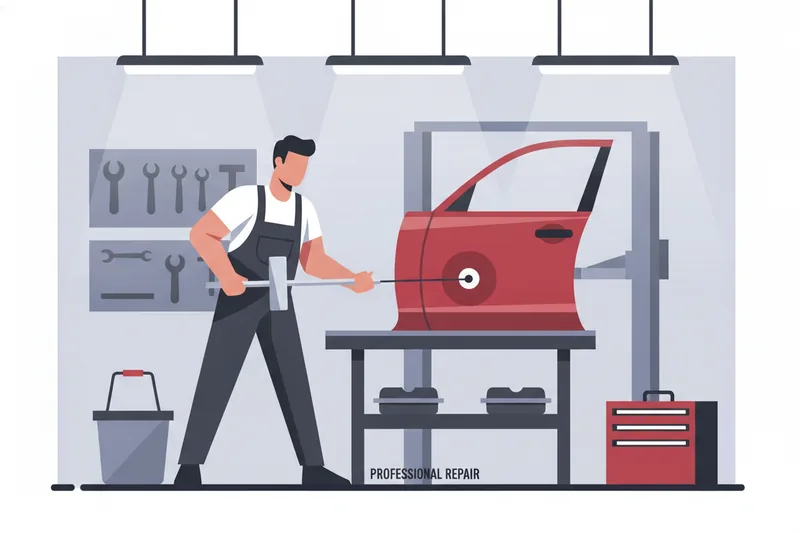
For large or severe dents, the pulling method that gives a professional technician the most control is a glue-pulling tab system — a tab bonded to the panel with cold or hot glue and worked with a slide hammer, bridge, or hand puller — rather than a suction cup or a generic pneumatic unit built for shallow consumer dings. Which exact setup to use still depends on the dent: depth, access, panel location, and paint condition all decide whether a bridge, a glue tab, or a combination gets the panel back to shape without creating a new problem. This guide walks through the main pulling methods, the criteria that separate them, and what changes when the work moves from a single dent to a full hail job.
What Counts as a Large Dent Puller — and the Core Pulling Methods
There's no single measurement that makes a dent "large" in PDR; it's a mix of span, depth, and how much surrounding metal is under tension. For broad or severe damage, the candidate approaches are a broad push from behind, a bridge or beam puller, cold or hot PDR glue, or a lateral/hybrid combination of these, backed by a good light, supports, and surface control to read the panel while it moves. Which one applies depends on whether the panel needs sustained pulling force, a fast impulse, or gradual lateral tension across a wider area. Exterior pulling with glue is one mechanical direction PDR uses; hot-melt and cold glue are simply two different attachment methods within it, not competing standards.
Suction Cup Pullers
A suction cup dent puller is a hand-operated rubber vacuum pad meant for large, shallow dings on flat panels. In professional shops it's used sparingly and is generally regarded as an entry-level approach rather than a production tool — its limits matter more than its reach, which the next section covers.
Bridge Pullers
A bridge puller is supported on opposite sides of the repair zone, spanning the dent rather than attaching to a single point. It's built for sustained, controlled tension rather than a quick pull.
Pneumatic Pullers
Pneumatic pullers use shop air to drive a pulling action, usually paired with a suction cup or a bridge-style attachment. They show up in some production settings where speed on moderate damage matters, but for large or complex dents, control over pull rate and direction tends to matter more than raw speed — which is where glue-based systems earn their place.
Glue-Pulling Tab Systems
A glue-pulling tab system bonds a tab to the panel with PDR glue and transfers force to it through a compatible pulling device — commonly a slide hammer, an inertial tool that delivers pull through a sudden impulse rather than steady tension. Cold glue in particular is a reusable, tacky or viscoelastic compound rather than a one-shot adhesive, which is part of why it fits repeated pulls on a single job.
The Principles That Decide Which Puller Fits the Dent
The most common mistake in choosing a puller is picking the device before assessing the damage, the finish, and the access. Depth alone doesn't settle it: a large dent doesn't automatically call for lateral tensioning, and a small, sharp dent doesn't rule out a hybrid approach — what matters is a separate read of the finish condition and where strain is concentrated. Vague language doesn't help here either; "dent extraction" isn't a method, it's a goal, so the decision has to name an actual device — mini lifter, bridge puller, slide hammer, or hand puller.
Panel access and condition rule out options as much as they recommend them. A suction cup puller has no real basis for being called the easiest, primary, or best precision-finishing method in PDR; its practical use is limited to coarse movement on a specific product, and it isn't a substitute for a glue tab, a precision method, or a handling lifter. It's also not well suited to sharp creases or deep sharp dings, and cracked paint on the panel calls for caution and disclosure rather than ruling the repair out outright — it changes the repair path more than it disqualifies the dent. Panel location adds another layer: a dent crossing a bodyline or sitting near a brace changes what can physically be bridged or reached, which is why the method decision has to follow the inspection, not precede it.
Glue-Pulling Reliability: Temperature, Surface Prep, and High-Volume Hail Work
Temperature and Glue Selection
Temperature is the first variable most technicians check, but it isn't the only one. Glue choice also follows pull dynamics and panel metal: a rigid, brittle glue suits a sharp, shock-style pull, while a more elastic glue suits a slow, sustained one. Cold glue's pull response in particular is shaped by tab area, shape, and stiffness, compound thickness and distribution, the specific chemistry's viscoelastic behavior, product/panel/ambient temperature, cleanliness and coating, contact duration and pull rate, pull direction, the type of puller used, and how much the compound has degraded through previous cycles. That's a long list of variables, which is why no single number works as a universal setting — matching glue to the day's conditions is a per-job judgment, not a fixed spec. There's also no established industry standard dictating cold glue before hot glue or vice versa; the sequence depends on the dent, and most shops keep both on hand.
Surface Prep Before Gluing a Tab
Surface prep for glue pulling is chemical, not mechanical: a cleaner or degreaser removes wax, ceramic coating, and road film that would otherwise sit between the tab and the paint and cut adhesion. Glue pulling has a real advantage here over weld-on pulling methods — it can preserve the exterior coating and the backside corrosion treatment — but that's a process advantage, not a guarantee that any given finish will hold a bond. Pulling has to stop if the paint cracks, delaminates, or becomes unstable, if filler or corrosion turns up, or if the pull starts creating expanding highs or instability. The same applies to cold glue specifically: stop if the finish changes, adhesion gets unpredictable, secondary damage shows up, the pull drags too much surrounding metal, or the glue isn't behaving the way the product instructions describe for that temperature.
Pulling Reliability in High-Volume Hail Jobs
Hail damage means dozens to hundreds of dents across the roof, hood, and decklid, varying in diameter and depth panel to panel. Cold glue pulling fits this work for broad initial movement, repeated-pull sequences, and large or complex damage, and it's also combined with backside pushing and hot-melt adhesive techniques where the panel calls for it. But no documented hail workflow treats cold glue as the sole method — real jobs combine lighting, hail rods and hand tools, whale tails, hot-glue tabs and pulling devices, knockdowns, cold glue where the product and the dent call for it, and removal/installation of trim as needed. For a high-volume shop, that means a continuous-work glue and tab setup matters less as a single product and more as part of a rotation of tools matched to each dent on the panel. The reusable nature of cold glue compound helps here, since a shop running dozens of pulls isn't re-bonding from scratch every time — though reuse still depends on the compound's condition and the manufacturer's instructions.
Choosing and Stocking a Professional Pulling System
Why PDR-Grade Tools Outperform DIY Kits
Consumer dent-removal kits generally build around one of three approaches — a suction puller, a glue-pull kit, or a rod kit — rather than one universal tool that handles everything. A production shop works the other way: it stocks for the dent in front of it, not for a single all-purpose device. "Puller" on its own is too vague a word to plan around — the working vocabulary is mini lifter, bridge puller, slide hammer, and hand puller, each suited to a different kind of pull, and professional kits typically include more than just those three obvious categories.
What a Production-Ready Pulling Kit Includes
Matching device to need looks like this: a mini lifter for a controlled, localized lever pull; a bridge or beam puller for a sustained pull with surrounding support; a slide hammer for a fast impulse pull; a T-handle puller — a compact hand-operated puller — for a manual, aligned pull; and, for large-scale metal reduction, a dedicated beam puller, pull tower, or glue-pull-repair system. Tab interface, access, panel support, and finish condition all factor into the final call. The reason a bridge or beam puller earns a place in a production kit is specific: it holds sustained tension on its own, freeing the technician's hands for simultaneous knockdown work, where a T-puller can't hold a stable load unassisted. A beam puller also extends span and can carry multiple feet or tabs, which matters on a bodyline dent or damage that runs the length of a panel. Tab choice itself isn't an afterthought — it has to account for the shape and scale of the low point, panel curvature, the direction load needs to transfer, tab stiffness, compatibility with the puller's adapter, and the panel material itself.
For a shop building out a large-dent and hail-repair kit, this points toward stocking glue-pulling tab systems and compatible pulling devices by category — tabs in a few sizes and stiffnesses, a slide hammer, a bridge puller for sustained work — and matching glue chemistry to the conditions the shop actually works in, rather than buying a single kit and expecting it to cover every panel that comes through the bay.
Frequently Asked Questions About Large Dent Pullers
What are the limits of a suction cup on a large dent? A suction cup puller isn't suited to sharp creases, deep sharp dings, or any panel with cracked paint, and there's no basis for treating it as the primary or most precise method for large-dent work.
What temperature range works for glue pulling? There's no single number that applies across products — glue selection follows ambient and panel temperature together with pull dynamics, and matching the glue to the day's conditions and the product's own instructions matters more than any fixed range.
Can pneumatic pullers handle hail dents? Documented hail workflows combine lighting, hail rods, hand tools, hot-glue tabs and pulling devices, knockdowns, and cold glue as the panel calls for it — not a single pneumatic tool, so most high-volume hail work runs on tab-and-pulling-device systems rather than air-powered pullers alone.
Choosing the right puller for a large dent comes down to reading the damage before reaching for a tool — depth, access, panel location, and paint condition first, device second. Once that assessment points toward a glue-pulling tab system, Glexo's range of professional glue-pulling tabs and systems is built around that same decision: matched to ambient temperature and surface condition, and sized for the kind of sustained, repeated pulling that large-dent and hail work demands. Explore the range to compare options suited to your shop's conditions.