Professional Paintless Dent Repair Tools: Pro vs Hobbyist
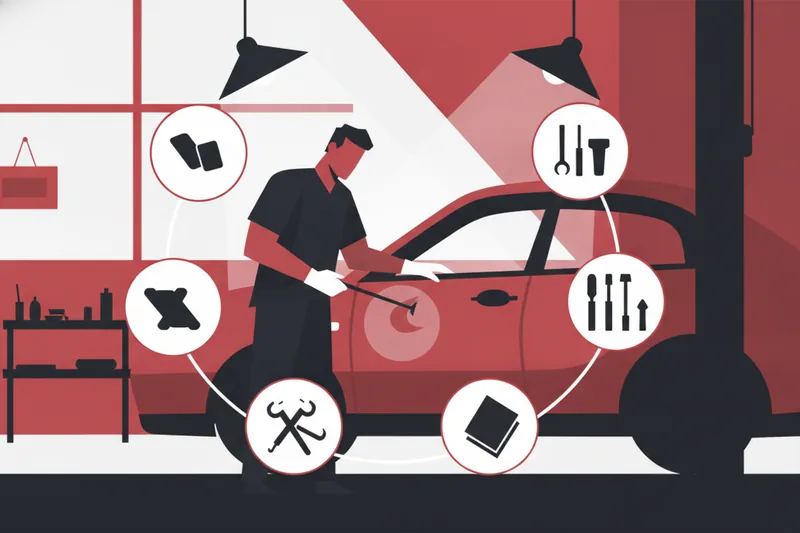
A professional paintless dent repair (PDR) setup is built around four interdependent categories — glue-pull systems, lifting tools, finishing tools, and surface prep — and it's the dent in front of you, not a parts list, that decides which version of each one belongs in your hands. The real gap between a hobbyist kit and a set of professional paintless dent repair tools shows up in whether the tab matches the glue, the glue matches the shop's ambient temperature, and the tip matches the access — not in how many pieces come in the box. This guide walks through those categories, how dent type and working conditions change the choice, and what separates a kit built to get through a season from one built to run a shop.
What Paintless Dent Repair Actually Requires Beyond Skill
How glue-pull repair works without repainting
Paintless dent repair is a group of professional methods that restores a metal panel's shape through controlled movement of the metal itself, while the existing factory or refinished surface stays on the car. "Paintless" describes the repair path and the result, not the absence of every material — the work routinely uses hot-melt adhesive, cold glue, cleaning agents, and protective accessories to get there. What it excludes is any step that leaves the finish needing correction afterward: self-tapping screws, welded studs, or sanding put a repair outside the paintless category entirely, no matter how well the metal was shaped.
Why generic tools risk panel damage
Because the finish has to survive the whole repair, tool choice isn't a convenience decision — it's what keeps the work paintless in the first place. A tab with the wrong adhesive interface, a tip with the wrong contact area, or a glue running past its working temperature doesn't just slow the job down; it risks a crease, a pushmark, or a bond that lets go mid-pull and sends the panel back further than where it started. The tool and the technique are the same decision, not two separate ones.
The Core Tool Categories of a Professional PDR Setup
These categories aren't ranked by how often they're used in the field — there's no established frequency count or mandatory kit, just functional roles that overlap depending on the job.
Glue-pull systems: tabs, cold glue, hot glue
Glue-pull repair attaches a tab to the panel and pulls through it instead of reaching the dent from behind. Cold glue is a reusable, tacky or viscoelastic compound applied to a compatible tab and worked with a compatible pulling device; since the compound is meant to be peeled and reused across pulls, it suits bulk movement and repeated-pull work such as hail. Hot glue pulling instead melts a glue stick to bond the tab to the panel for that single pull, then releases it afterward. Neither is a universal upgrade over the other — the choice depends on the damage, the finish, the ambient temperature, and what the pulling device needs to grip, not on which method is newer. Pull response itself depends on more than the glue alone: tab area and stiffness, compound thickness, panel and ambient temperature, surface cleanliness, and puller type all change how a tab releases a dent.
Slide hammers, bridge pullers, and dent lifters
A slide hammer is an inertial pulling device: a weight travels along a shaft and strikes a stop to transmit a sharp pull through the tab. A bridge puller instead spans and supports opposite sides of the repair zone, which suits broad or large-panel damage where a single point of pull would distort the surrounding metal — on that kind of job, adequate light, supports, and controlled surface reading matter as much as the puller itself. Alongside both, compact hand-operated mini lifters or bridge lifters apply direct pull without inertia, for smaller or more controlled pulls where a swinging weight would overdo it.
Knockdown, blending, and sonic tips for finishing
Finishing calls for a different load profile than lifting, and the terms are worth separating by function before they're separated by name: a specialized tool is best introduced by what it does, then by what it's called, which is why the sonic tip line is named for a product family, not for a sound-based way of working. A knockdown applies controlled action to a raised transition through a series of small strikes, with the result read continuously against a reflection rather than judged by feel. A blending hammer manages a broader high or transition; blending names the surface work, not one fixed tool or a stage every repair has to pass through. For internal access, sonic tips come in soft, rounded profiles and sharper, pointed ones, letting a technician match contact pressure to how the metal needs to move.
Surface-prep wipes and adhesion
Glue only holds as well as the surface underneath it. Surface preparation means chemical cleaning — isopropyl alcohol or a PDR-specific degreaser — to strip wax, ceramic coating, sealant, and road film, each of which acts as a separator and cuts glue adhesion. Disposable prep wipes exist mainly to make that step repeatable between pulls, which matters most on older paint or on a panel carrying a protective coating, where adhesion was already working against you before the tab went on.
Matching Tools to Dent Type, Access, and Shop Temperature
That choice runs through a stack of checks rather than a single rule of thumb: OEM restrictions and safety come first, then the part and its substrate, the finish, the damage itself, the access available, and only then the specific tool — not the dent's size alone.
Choosing tools for hail, dings, and creases
Hail repairability has to be judged by panel, damage group, finish condition, and access, checked against the applicable original equipment manufacturer (OEM) repair restrictions, which typically limit or prohibit metal repair on certain structural or safety-related panels — a hail dent isn't automatically a PDR candidate just because it looks small. A single dent can be a door ding, a sharp crease, and bodyline damage at once, and these aren't three points on one difficulty scale; they're three separate things a tool choice has to account for together. Shortcuts like treating every hail dent as a slide-hammer job, or every bodyline dent as a crease-tab job, skip the checks that actually decide the right tool. The slide hammer does carry a documented role in hail and roughing work, though lighter variants are built for more precise single pulls — so it isn't a tool tied to one damage size. On a hail vehicle specifically, the decision typically runs across several levels — the vehicle, the panel, and each individual dent — and a conclusion about one dent doesn't multiply out to cover the rest of the panel.
Interior and hard-to-reach panel access
Where there's no usable backside access — a double-panel section, a brace in the way, a cavity that can't be reached without R&I — the candidate approach shifts to exterior pulling with hot-melt adhesive or cold glue, checked against the finish and the applicable repair information rather than assumed. Where some backside access does exist but it's tight, under-brace tools and whale tails — thin, broad backside push tools built for restricted spaces — extend reach without full disassembly.
Glue selection across shop temperatures
Cold glue's performance shifts with temperature, cleanliness, and how it's been stored, so the same compound doesn't pull the same way on a cold morning as it does on a panel baking in direct sun. Hot glue sticks are also made in temperature-specific formulations — for example, darker sticks are built to stay workable in hot conditions while lighter-colored sticks are built for cold conditions — so matching the stick to the day's temperature matters for hot glue as well as cold. Check the glue's labeled working-temperature range before the job, rather than assuming it matches a different glue or a different day. A shop running jobs across a full range of outdoor conditions typically keeps more than one cold-glue variant on hand for that reason, instead of relying on a single compound to perform year-round.
Beginner Kit vs Professional Setup: What to Choose
Signs of a hobbyist kit vs a pro-grade system
A hobbyist kit is usually sold as one fixed bundle — one hammer weight, one tip shape, one glue — meant to cover every dent a buyer might meet. Professional paintless dent repair tools get assembled by category instead: enough variation within tabs, glue variants, tip profiles, and hammer weights to match the job, rather than forcing the job to fit whatever is in the case. Real PDR workflows combine tools and methods — lighting, rods, hand tools, whale tails, tabs, pulling devices, knockdowns, glue — differently from one job to the next, which is exactly why a working kit grows by category and by the work it actually sees, not by buying a bigger box.
Evaluating tip finish, glue consistency, and hammer control
A few signals carry across brands. Tip finish matters on anything that contacts metal under impact — a mirror-polished or chrome-finished knockdown or blending tip is less likely to mark the panel than a rough-cast one. Hammer weight is a real selection criterion, not a preference: blending hammers used in PDR generally fall within a lighter-to-midweight range, with many professionals favoring the lighter end of that range for finer control, because a hammer that's too light won't move the metal and one that's too heavy loses control at the point of contact. Glue consistency is harder to judge off a spec sheet; it shows up in whether a compound holds a steady tack across a full day of repeated pulls rather than softening or skinning over partway through.
Matching categories to your repair volume
A technician handling occasional dings needs fewer variants in each category than a shop running continuous hail volume, where redundant tabs, a cold glue suited to extended outdoor work, and a lifting tool built for repeated cycles all earn their keep. The categories don't change between those two technicians — how deep each one is stocked does.
If you're building that depth around hail season specifically, a cold-glue system paired with hail-specific tabs covers the repeated-pull volume that kind of work demands, while a shop split between tight winter mornings and hot summer afternoons benefits from stocking separate temperature-range cold glue variants rather than pushing one compound outside its working range. For finishing work on tight interior access, Sonic tips in both soft and sharp head profiles let a technician match contact pressure to the metal without swapping tool families mid-job.
Once you know which categories your own work demands, the next step is comparing options inside each one — tab geometry, glue variant, tip finish, hammer weight — against the dents you repair most often. Glexo's range of professional PDR tools and consumables is organized the same way, by category and working condition, so you can match a system to your repair volume and shop conditions instead of working around a generic bundle.