Paintless Dent Repair Kit for Hail Damage | Pro Setup
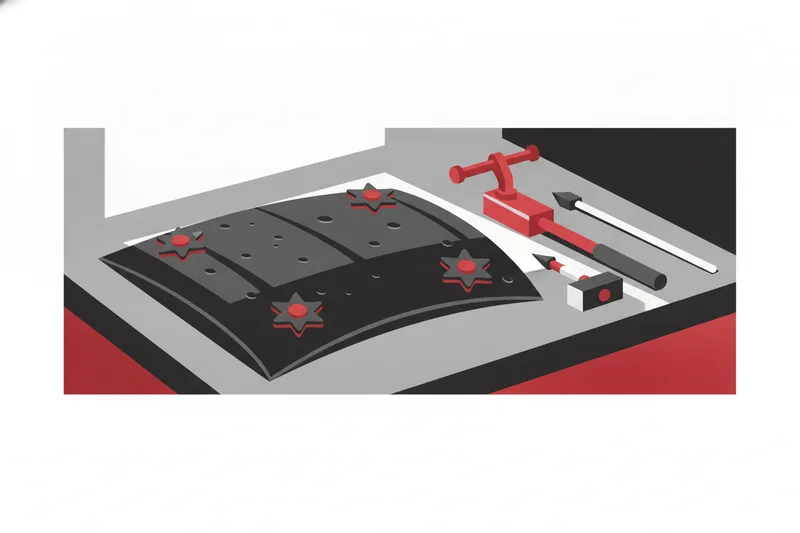
A professional hail-damage paintless dent repair kit succeeds or fails on three things: a cold-glue system matched to the day's ambient temperature, enough tabs and consumables on hand that a pull never has to wait, and the right mix of internal-access tools and slide hammers for whatever access each dent allows. Hail jobs aren't single-dent repairs — a hood or roof can carry dozens to hundreds of dents of varying size, and a kit built for one-off door dings bottlenecks the moment a technician has to work an entire panel in one session. This guide covers professional paintless dent repair for hail damage from the ground up: how glue pulling actually lifts metal, why temperature governs glue selection, what surface prep has to happen before any tab goes down, and what separates a kit built for hail-season volume from a general paintless dent repair kit for hail damage.
How the Glue-Pulling Method Works on Hail Dents
Glue pulling is one of the exterior PDR methods used in hail repair, typically combined with hand tools, hot-glue tabs and pulling devices, knockdowns, and R&I as the job requires: a tab is bonded to the finish with an adhesive, connected to a pulling device, and used to draw the dent back toward its original plane without removing paint or drilling access holes. Two adhesive systems do this work. Cold glue pulling uses a reusable tacky or viscoelastic compound applied to a compatible tab; because the compound generally stays usable for another pull once the tab is cleaned, a PDR technician can move through many dents without reloading a glue gun each time. Hot glue pulling instead bonds the tab to the panel with a PDR hot-melt adhesive from a glue gun, and that bond is broken rather than reused. Once the tab is set, a pulling device — a hand puller, a bridge puller, or a slide hammer — applies tension gradually, checking the panel against a reflection board as the low lifts, rather than forcing the dent flat in one motion.
Why glue-pulling suits hail dents specifically
Cold glue suits large shallow dents and heavy hail damage because it moves broad, relatively uniform areas of metal without the sharp, concentrated force hot glue delivers on a single deep point. That's also its limit: on a very deep, small-diameter dent, cold glue lacks hot glue's pinpoint pulling power, which is why most hail workflows pair the two methods — broad adhesive pulls for bulk movement, hot glue and finishing tools for whatever lows resist that bulk approach, and steady use of a blending hammer throughout to relieve stress as the metal moves. Dents that cross or sit near two intersecting body lines sometimes respond poorly to glue pulling, so those spots get judged individually rather than assumed to pull like the rest of the panel.
Why Temperature-Matched Cold Glue Selection Matters
Cold glue's performance isn't fixed — it shifts with temperature, cleanliness, and how the product has been stored, so the same compound that tacks reliably on a cool morning can behave inconsistently once a shop or job site heats up. Viscosity — how thick or fluid the compound is — is the property manufacturers tune for each range: a cooler-weather glue has to flow and tack at lower temperatures without going hard, while a warm-weather version has to resist thinning out and losing grip as the panel heats up. That's why cold glue comes in ambient-range variants rather than one formula for every condition — a compound rated for use up to roughly 86°F (30°C) behaves differently once air and panel temperature climb past that point, and a separate above-86°F variant is built to hold tack in that heat instead of softening. A technician working through shifting hail-season temperatures needs to confirm which variant is rated for the heat they're actually in, not assume last week's glue performs the same today. Hot glue isn't exempt either — PDR glue sticks are also sold in temperature-specific versions, because warm- and cold-weather compounds flow and set differently at the gun.
Temperature isn't the whole picture. A sharp, shock-style pull calls for a more rigid, brittle glue, while a slow, sustained pull suits a more elastic one, and the panel's own metal temperature factors in alongside ambient air. Cold and hot glue also aren't a strict hierarchy — which goes first in a repair plan depends on the damage, the finish, the temperature, and how the tab interfaces with the panel. Mid-pull, a few signs mean stop and reassess: a finish change, unpredictable adhesion, new secondary damage, or glue behavior that doesn't match what the product's instructions describe for that temperature.
Surface Prep Requirements for Reliable Glue Adhesion
No glue system compensates for a dirty or unknown panel. Surface prep means chemically cleaning the work area — typically with isopropyl alcohol or a PDR-specific degreaser — to strip wax, sealants, ceramic coatings and road film, each of which separates adhesive from paint and cuts tack strength. Cleaning, adhesion promotion and glue removal are three distinct jobs even when one product performs more than one of them, and treating them as interchangeable is a common cause of failed bonds.
A few conditions call for extra caution before any tab goes down: unknown refinish history, filler underneath, a cracking or delaminating clearcoat, a matte or satin finish, a ceramic coating or sealant, PPF, a wrap or decal, or exposed substrate or corrosion. A previously repainted panel carries uncertain adhesion and flexibility and may hide filler that changes how it responds to a pull — worth confirming before committing glue rather than finding out mid-pull. On any panel that raises doubt, setting one tab in an inconspicuous spot and running a light test pull before committing to the full repair shows whether the glue is actually gripping that finish.
Beyond the finish itself, a few compatibility points decide whether a glue-pull setup holds: the cleaner or release agent with the finish, the adhesive with the tab, the tab with the panel, and the adapter with the puller. Running through that chain before a hail job, rather than improvising it dent by dent, is what keeps a tab from letting go mid-pull.
Tools and Equipment Used in Hail PDR
A hail kit centers on tabs, a cold-glue system, pulling devices, and finishing tools — the core of any paintless dent repair kit for hail damage built for volume rather than occasional dings. Tabs need enough shapes and sizes to seat on round dents, creases, and dents sitting close to a flange or body line without crowding the next one over. Slide hammers — inertial pulling devices that use a sliding weight to deliver repeated pulling force through a tab — do the heavier lifting once a dent is bonded. A lighting board to read the panel and a knockdown tool for finishing round out the core set; beyond that, the mix of hooks, whale tails and specialty pullers a technician adds depends on the specific access and damage on hand, not a fixed checklist.
Sonic tips vs hammers for internal access
For dents reachable from behind, the choice is usually between a sonic tip on a knockdown-style tool and a slide hammer from the outside. Sonic tips — interchangeable soft or sharp working ends — let a technician work a stretched area with light, repeated contact instead of one hard pull, which suits settling metal gradually while keeping pushmarks (the small marks or texture irregularities a backside tool leaves when contact isn't controlled) to a minimum. A soft tip spreads contact for broader, shallower movement; a sharp tip concentrates force on a tighter spot. A slide hammer earns its place when a dent is too deep or too firmly set for internal tapping to move efficiently, or when there's no useful backside access and the pull has to come from the exterior tab instead. Most hail jobs use both, switching tool by tool as access and depth change panel to panel.
Limitations of PDR Tied to Tool and Technique Choice
A bigger tool roll doesn't fix bad method selection — more tools in a kit has never meant higher repair quality on its own, and paintless dent repair for hail damage still runs into limits the dent and panel set, not the inventory. Deep, sharp creases are the clearest case: cold glue's bulk-movement strength doesn't translate to a tight, deep fold, which is why a technician reaches for hot glue, a finishing hook, or accepts that a given crease sits outside what glue pulling resolves alone. Access is the second limiter — a dent with no route for a backside tool restricts the technician to tab-and-pull methods regardless of preference, and picking a pulling device before confirming damage, finish and access is a documented way repairs go wrong. Larger or combined damage rarely resolves with one device either, since broad movement, sustained tension and precise finishing are often three separate needs on the same panel.
Paint condition is the third limit: a refinished panel, a questionable clearcoat, or unknown filler underneath raises the risk for both backside pushing and glue pulling, and that calls for a product-specific look rather than one rule applied to every panel.
What a High-Volume Hail-Season Kit Should Include
A general PDR kit covers one dent at a time. A hail-season kit has to sustain dozens to hundreds of dents across a hood, roof or decklid in one job without the technician stopping to restock mid-panel — which is less about owning more tools and more about owning enough of the right ones. Scaling starts with mapping the job: panel-by-panel dent counts and categories, anything oversized or severe, panels needing conventional repair or R&I instead of PDR, and any glass, trim or prior damage that changes the plan. Not every dent on a hail-damaged panel is automatically a PDR candidate — repairability depends on the panel, the damage group, the finish, and access, and that call gets made before the kit is built for the job.
With that assessment done, four categories decide whether a kit actually keeps pace on a high-volume day. A temperature-matched cold-glue system has to cover the range a shop actually works in, since a single compound rated for one climate loses consistent tack the moment conditions shift outside it. A redundant tab assortment matters just as much: enough shapes and spares on hand that a technician never pauses a job to clean and reuse the same handful of tabs between pulls. A sonic tip set earns its place for shallow-to-moderate dents with backside access, settling metal gradually and keeping pushmarks down in a way a slide hammer's sharper force doesn't. And a slide hammer still has to be in the bag for the dents a sonic tip can't move — deeper damage, or spots with no backside route, where the pull has to come from the exterior tab with real pulling force behind it.
Bridging to a Glexo-built hail-season kit
None of this works as four isolated purchases. A cold-glue system, a tab assortment, a sonic tip set and a slide hammer only function as a kit when the glue is rated for the climate a shop actually works in and the tab stock matches the pulling hardware on hand. The brand builds its paintless dent repair tools and consumables — cold-glue systems, tabs, sonic tips, and blending and knockdown tools — for that kind of coordinated hail-season use rather than as one-off accessories. If you're assembling or restocking a kit ahead of hail season, explore Glexo's range of cold-glue systems, tabs, and sonic tips built for hail-season PDR work to put together the combination that fits your shop's volume and climate.