Best Cordless Glue Gun for Professional PDR
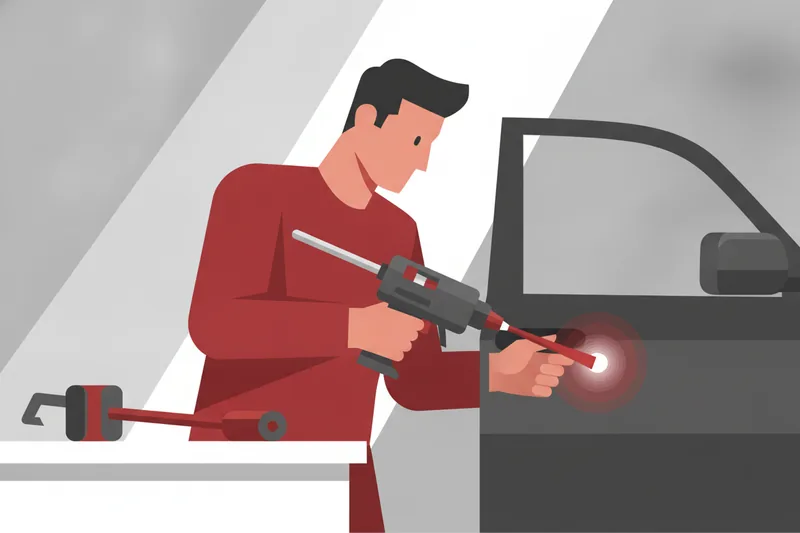
The best cordless glue gun for professional hot-glue dent pulling is the one that holds its heat through repeated triggers, matches temperature to the glue stick you're running, and survives a full shift away from an outlet — not the lightest, cheapest model topping a craft blog's "top 10" list. Most glue gun roundups online are written for scrapbookers and florists, where a single dab every few minutes is the hardest job the tool will ever face. A PDR or body-repair technician needs different answers: how many watts keep the nozzle flowing through a hail session, does the gun offer real temperature control, and will the battery hold up for a full day of pulls. This guide works through those questions in order, then covers what to run through the gun once it's chosen.
What Is a Cordless Glue Gun?
A cordless glue gun is a battery-powered hand tool that melts a solid glue stick inside a heating element and pushes it out through a nozzle on trigger pressure, with no cord tying you to an outlet. Most cordless glue guns on the market are built for craft and hobby use — scrapbooking, costume work, light household fixes — where melt volume and heat recovery barely matter because the next dab is seconds away.
In PDR, "hot glue gun" and "cordless glue gun" mean this same hot-melt tool, distinct from cold glue pulling, which uses a reusable tacky compound pressed straight onto a glue tab and needs no gun at all. Glexo's cold-glue systems work this way, built around tabs and compound rather than a heated tool. One thing worth knowing before you shop: a glue gun's dial sets the heater's target, not the actual temperature the glue reaches on the panel, so two guns on the "same" setting can still behave differently.
Wattage, Temperature and Battery: The Specs That Actually Matter
Three numbers decide whether a cordless gun keeps up with real repair work: wattage, temperature control, and battery runtime.
Why Wattage Affects Melt Time and Flow
Wattage determines how fast the heating element recovers after a trigger's worth of glue leaves the nozzle. Craft-grade guns commonly sit around 20 watts — fine for one dab every few minutes, but they lag once you're gluing tab after tab on a hail panel. Guns running closer to 60 watts melt faster and recover between triggers instead of falling behind, which shows most during back-to-back pulls.
Dual Temperature vs Single Temperature
A single-temperature gun runs one fixed heat setting, adequate only if you stick to one brand of glue. A dual-temperature gun lets you drop to a lower setting for delicate, trim-adjacent work and step up for stronger initial tack on a cooler panel. Stick color or size doesn't indicate strength or heat needs, so match settings to the stick manufacturer's guidance rather than a general rule — a setting dialed in for one brand won't transfer to another. And heat near a damaged high-voltage EV or hybrid battery is only safe when the automaker's repair information permits it, same as with any other heat source.
Cordless vs Corded Glue Guns: Pros and Cons for Body-Repair Work
Cordless wins on portability on the shop floor: you can work a hood, a roof, or the far side of a vehicle parked nose-in without a cord crossing wet concrete or another tech's workspace, which matters on a hail job where you're moving panel to panel all day. Corded guns win on consistent heat retention — plugged into mains power, they don't lose output as a battery drains, so the last pull of a long session runs the same as the first.
Hot-glue pulling earns its place in a repair plan particularly when backside access isn't available, or when pulling from the exterior better matches the direction the metal needs to move. That's a case-by-case call, not a default for every access problem — some small dents along a tight body line respond poorly to glue pulling regardless of which gun applied it. The corded-versus-cordless question only matters once glue pulling is already the right method for that dent.
Best Cordless Glue Guns Compared
Ryobi ONE+ Cordless Glue Gun
Ryobi, a manufacturer better known for cordless power tools, builds its cordless glue gun on the same ONE+ battery platform as its drills and saws — a real convenience for a shop that already runs ONE+ batteries, since it means one charger and one battery size instead of another proprietary cell to keep topped up. It's still designed around a general power-tool catalog rather than a PDR-specific spec sheet, so treat it as dependable for field touch-ups and occasional pulls, not as the primary gun in a high-volume bay.
Surebonder Cordless Models
Surebonder's cordless glue guns run on the Bosch® 18V battery platform, letting a shop that already carries Bosch power tools share chargers and batteries instead of adding another proprietary cell. That shared-platform design still comes with grip control tuned for sustained one-handed use through many short bursts, and a wider spread of nozzle and temperature options than a single-platform tool usually offers.
What to Look for Beyond the Big Names
Whatever brand you're weighing, check the battery platform (shared with tools you already own, or another proprietary cell to charge), the wattage class, whether temperature is adjustable or fixed, and how the grip holds up through a full shift of repeated triggering.
| Model type | Battery platform | Temperature control | Best suited for |
|---|---|---|---|
| Ryobi ONE+ Glue Gun | Shared with ONE+ power tools | Single setting | Shops on ONE+, occasional field touch-ups |
| Surebonder cordless | Dedicated proprietary battery | Single or dual, model-dependent | Technicians wanting a dedicated glue tool |
| Generic craft cordless gun | Low-capacity proprietary | Single, low wattage | Not suited to daily PDR volume |
Best Glue Sticks to Use With a Cordless Glue Gun
The gun is only half the equation; the stick decides how well the glue actually bonds. Glue stick compatibility isn't universal — color and stick size are marketing cues, not a performance classification. When you switch brands, run the gun empty first, a practice technicians call purging, so leftover residue from the old stick doesn't undercut adhesion on the new one.
Hot glue, done right, delivers strong adhesion and can generate real pulling force on stubborn, sharp, or deep dents — it isn't a weaker fallback next to cold glue, just a different tool for a different kind of pull. Cold glue, by contrast, is a reusable tacky compound applied straight to the tab with no gun or heat step, and it peels off cleanly for reuse once a pull is done.
Adhesion performance depends on what's under the glue more than on any gun spec. Wax, sealant, ceramic coating, and road film all act as separators that cut adhesion, so cleaning the panel with isopropyl alcohol or a PDR-specific degreaser before gluing matters as much as the equipment itself.
How to Choose a Cordless Glue Gun for PDR and Body-Repair Work
Match the tool to the job, not the other way around. A common workflow runs cold glue first for fast, broad movement across large or shallow damage, then switches to hot glue — and a cordless gun — for the pinpoint, fine-detail pulls cold glue isn't built for on deep, sharp dents.
Before buying, work through:
- Battery runtime against your actual session length, not a marketing claim.
- Heat recovery under repeated triggers, not a single demo pull.
- Compatibility with the hot glue sticks you already trust for adhesion.
- Set-up time: a hot glue pull needs the glue to cool and bond, roughly 8 minutes and up to 10 in a cold shop, before you load a pull — budget for that instead of rushing it.
- Finish risk: glue-based pulling is generally gentler on existing coating and corrosion protection than weld-on methods, but that's not a guarantee on every finish, so test an unfamiliar or heavily coated panel before committing.
A cordless glue gun is one piece of a kit, not the whole kit — rods, whale tails, LED reflector boards, tap-down pens, and knockdown tools still handle the backside and finishing work a glue gun can't touch.
Are Cordless Hot Glue Guns Worth It for Professionals?
Yes, with conditions. No single tool or method is the industry standard for PDR pulling, and hot-melt pulling remains a current, valid technique — so a cordless gun earns a place in a professional kit once it clears a real reliability bar: steady heat recovery, a battery that survives a full session, and dependable glue stick compatibility. Below that bar, a cordless gun is still a craft tool wearing a work glove.
FAQ
What's the difference between craft and professional use of a cordless glue gun?
Craft and hobby use asks little of the tool — one dab every few minutes at low wattage. Professional PDR work demands sustained output and a battery that lasts a full session, which most craft-grade guns can't deliver.
Can a cordless glue gun replace cold glue pulling?
No. Cordless hot glue guns suit fine, pinpoint pulls on deep or small dents; cold glue, used without any gun, suits broad initial movement on large or shallow damage and repeated hail pulls.
How long does hot glue need before I can pull?
About 8 minutes, up to 10 in a cold shop, for the glue to cool and bond — pulling sooner risks a failed grab.
Once the gun is sorted, the stick matters just as much: pair it with Glexo's professional-grade hot glue sticks, engineered for strong, consistent adhesion on PDR and body-repair jobs, and ask about Glexo's discounts for regular customers.