Cold Glue PDR Tabs for Hail Repair: Professional Guide
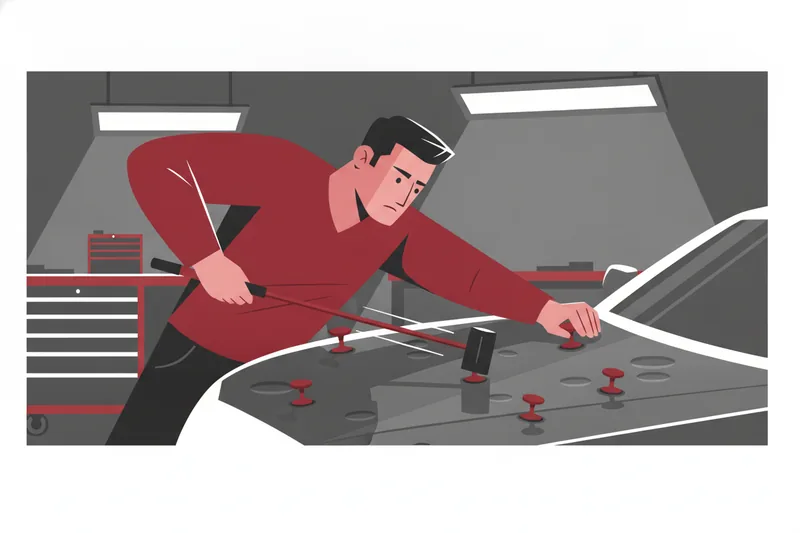
Cold glue PDR tabs let a technician pull hail dents from the outside of a panel without drilling, welding, or risking the paint film — provided the glue formula matches the day's temperature and the surface is prepped correctly first. This guide walks through how the tab-and-glue system works, how to match compound to conditions and panel type, and the step-by-step technique that keeps pulls consistent across a full hail claim instead of failing halfway through a panel.
What Is Cold Glue PDR and How Does It Work for Hail Damage
Cold glue is a ready-to-use, reusable tacky or viscoelastic compound applied to a glue tab — an exterior bonded attachment through which pulling force is transferred into the panel. Unlike hot-melt adhesive, cold glue is a single-component product, not a two-part or structural adhesive. The tab bonds to the outside of the dented panel; a slide hammer, an inertial pulling device, is then connected to the tab and used to draw the metal back toward its original shape without removing paint or accessing the panel from behind. This is why the process is called glue pulling: pull is generated at the finish surface rather than by pushing rods against the backside.
Many Glexo tab systems use an O-ring locking system to seat the tab securely on its adapter, keeping the connection tight through repeated hail pulls rather than working loose mid-session.
Why cold glue suits hail damage specifically
Hail dents are typically shallow, widely distributed, and repeated hundreds of times per vehicle — conditions where an exterior pull that doesn't require backside access is often the practical choice. Cold glue pulling covers broad initial movement and repeated-pull hail workflows without needing a hot-melt bonding step for every dent. It's worth noting that both PDR and glue-pull repair are classified by I-CAR as forms of cold straightening, so any OEM restriction on cold straightening for a given part still applies regardless of which panel or exterior location is involved.
Temperature Considerations and Glue Selection
Glue chemistry behaves differently as ambient and panel temperature change, which is why temperature-specific glue formulas exist rather than one universal mix. Glexo's cold glue line includes a variant built for use up to 86°F/30°C and a separate variant for work above 86°F/30°C, so the tack and body of the compound stay predictable instead of turning soft and slow in heat or stiff and unresponsive in cold.
Cold weather vs warm weather glue behavior
A glue gun's dial setting is not the same thing as actual panel temperature or the temperature at the adhesive bond line — the two can diverge significantly on a hot roof versus a shaded quarter panel. Warming a glue system into working condition also does not grant permission to heat the panel itself; conditioning the adhesive and heating the substrate are separate actions with separate rules. Because cold glue is reusable only within the product's condition limits, and that condition depends on temperature, cleanliness, and storage, a compound left in the wrong thermal range degrades faster and delivers less consistent tack and cure behavior. Settings and color coding are also not transferable across brands — one manufacturer's number or shade doesn't map onto another's chemistry.
Surface Prep for Maximum Adhesion
Adhesion strength is decided before the tab ever touches the panel. Surface preparation — cleaner, adhesion promoter, and release/removal solution are three distinct functional roles, even when one product performs more than one of them — removes wax, road film, and residue that would otherwise sit between compound and finish.
SPS surface-prep wipes are built for this step: a disposable, wet wipe used for deep cleaning immediately before tabbing, aimed at improving stick/cold-glue adhesion even on older paint or coated surfaces.
Contaminated or coated paint needs extra attention. A ceramic coating can reduce glue-tab adhesion, and I-CAR cites guidance to remove it per the coating manufacturer's instructions before relying on a tab bond. Any refinish, filler, wrap, PPF, or unknown coating stack calls for case-specific assessment rather than an assumed outcome, and a previously repainted door in particular carries less certain adhesion and flexibility, with concealed filler changing how the panel actually responds. Glue pulling can preserve the exterior coating better than weld-on pulling methods, but that's a process advantage, not a guarantee that any given finish will hold the bond.
How to Choose the Right Tab Size and Glue Formula for Hail Damage
Tab size selection starts with dent diameter matching — a tab close to the dent's footprint distributes pull evenly across the deformed area instead of concentrating stress at one edge. Before sizing anything, though, the damage itself needs mapping: a proper hail damage assessment records panel-by-panel dent counts and categories, oversize or severe damage, and any panel that needs conventional repair, replacement, or R&I rather than PDR. That assessment has to work at three levels — vehicle, panel, and individual damage-system — because a conclusion about one dent can't simply be multiplied across the car. In practice this means repairability by panel, damage group, finish, and OEM rule, not an assumption that every dent qualifies for PDR.
Panel material matters too: aluminum panels and areas near two intersecting bodylines — stamped feature or character lines — respond differently than a flat steel skin, and I-CAR notes some small dents near two bodylines respond poorly to glue pulling, making method choice a per-dent decision rather than a blanket rule. A tab's texture, color, or smoothness is not a universal strength code, so selection should be based on the manufacturer's stated compatibility, not visual assumptions.
Best Cold Glue Tabs and Kits for High-Volume Hail Repair
Cold glue's practical advantage in continuous hail work is that it doesn't require a heat gun at all: it's a cohesive, putty-like compound that peels cleanly off the panel with essentially no residue and goes back onto a tab for the next pull. It also doesn't need a dedicated "cold-glue gun" — the compound is simply worked onto a compatible tab by hand. That's what makes it suited to hail volume: a technician can cycle through dozens of small pulls per panel without pausing for adhesive to melt or cool.
What a well-stocked hail kit should contain
Glexo's hail repair kits and micro kits are built around this cycle — a range of tab sizes for shallow crowns and small hail pits, O-ring locking tabs for a secure adapter connection, and enough redundant tabs on hand that a technician isn't stopping mid-panel to clean and reload the same one. There's no fixed rule that cold glue must precede or follow hot glue in a repair plan — the sequence is set by the job, not by convention — so a kit built for hail work is often paired with a separate hot-melt setup for the occasional deep, sharp dent that falls outside cold glue's strength.
Step-by-Step: Applying Cold Glue Tabs for Hail Pulls
- Clean the surface. Wipe the work area with an SPS surface-prep wipe to strip wax, film, and contaminants before any adhesive touches the panel.
- Apply glue to the tab. Work a temperature-appropriate cold glue evenly across the glue tab's contact face — enough coverage to bond fully, not so much that it squeezes out unevenly.
- Twist the tab onto the dent center. Press and twist the tab directly over the center of the dent to seat the compound against the metal and eliminate air pockets.
- Allow tack/cure time. Let the compound reach working tack before connecting a puller — pulling too early is one of the most common causes of a failed bond.
- Attach the slide hammer and pull. Connect the slide hammer to the tab and apply controlled, incremental pulls, watching panel response rather than pulling to a fixed number of strikes.
The load path runs from the pulling device through the adapter and tab, through the cold-glue compound, through the finish, and finally into the panel — so a weak link anywhere in that chain, not just at the glue, can be the real cause of a pull that doesn't move the metal.
Ordering tabs on large hail panels for efficiency
On a roof or hood with dozens of hits, work in a consistent pattern — row by row, or from the panel's center outward — rather than jumping between dents at random. This keeps prepped, glued tabs curing in sequence so the technician is always pulling one while the next is setting, instead of waiting idle between pulls.
Common Mistakes and Troubleshooting Glue Pulls
Premature pulling before cure is the single most common failure: pulling before the compound reaches working tack under-loads the bond and invites tab pop-off. Poor surface prep does the same thing from the other direction — residue or coating left on the panel gives the compound nothing solid to grip, and the tab releases mid-pull.
Pushmarks and localized highs usually trace back to pull angle, not the glue itself: an off-axis pull can displace an adjacent area instead of the intended dent, and a slide-hammer's sharp impulse behaves differently than a sustained lifter pull, so the tool has to match the repair, not just the dent size. Pull response overall depends on tab area and shape, compound thickness, chemistry, temperature of product/panel/ambient air, cleanliness, contact duration, pull direction, and the compound's condition after prior cycles — a lot of variables can hide behind what looks like "bad glue".
Wrong-temperature glue shows up as inconsistent tack — too soft to hold, or too stiff to seat — and is best diagnosed by checking the product's stated range against actual panel temperature, not the glue gun dial. Before blaming the compound, confirm the basics: finish with cleaner, adhesive with tab, tab with panel, and tab neck with adapter all need to be compatible pairs, since a mismatch anywhere in that chain reads as a glue failure even when the glue is fine. If a pull isn't working, diagnose which failure mode is happening — the adhesive itself fracturing, release from the tab, or release from the finish — rather than repeating the same pull and hoping. Stop the pull altogether if the finish changes, adhesion becomes unpredictable, secondary damage appears, or the pull is moving more of the surrounding panel than intended.
FAQ
How do I use cold glue correctly? Clean the surface, apply a temperature-matched cold glue to the tab, twist the tab onto the dent center, let it reach working tack, then pull with a compatible slide hammer or lifter — checking panel response as you go rather than pulling to a fixed count.
Does PDR work on hail damage? Yes — hail damage is one of PDR's most common applications, and glue pulling in particular suits the high volume of shallow, widely spread dents typical of hail claims.
How long does cold glue take to release? Release time depends on the specific product, temperature, and pull conditions rather than a fixed number across all cold glues; check the manufacturer's instructions for the compound in use.
Can cold glue tabs be reused? The compound is designed to be reusable within its condition limits — it can be peeled off and reapplied as long as cleanliness, storage, and temperature stay within what the product allows.
Browse Glexo's cold glue tab systems and hail repair kits, and ask about volume discounts for regular customers running continuous hail claims.