Body Shop Supplies: Complete Stocking Guide
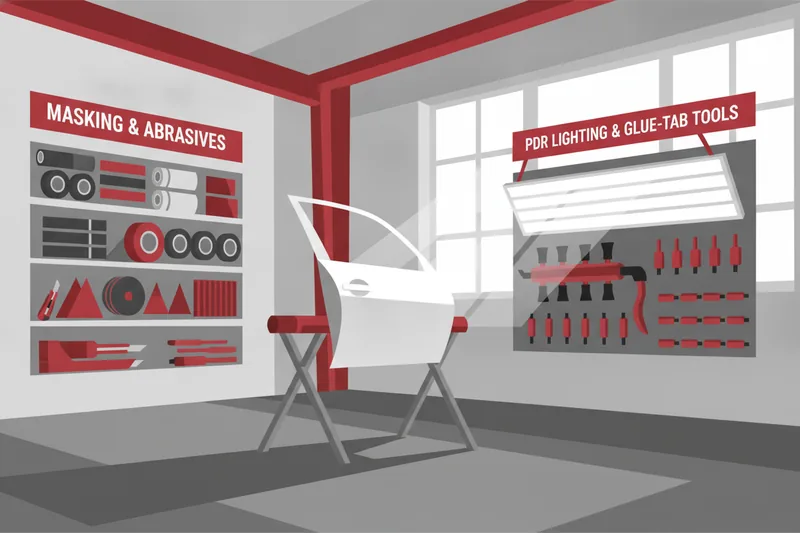
A body shop needs supplies in five working categories: paint and refinishing, PPE and consumable wear items, abrasives, general shop equipment, and dent repair tools — and that last category splits further into conventional bodywork and paintless dent repair (PDR), which runs on a different consumable set entirely. Most buying guides stop at the first four and treat dent repair as an afterthought, which is exactly how a shop ends up short on cold glue or tabs mid-season. The categories below map the full stock list, the criteria that separate professional-grade product from hardware-store substitutes, and where PDR consumables specifically belong in it.
What Counts as Body Shop Supplies: The Core Categories
Supplies, tools, accessories, and consumables aren't interchangeable terms, even though shops use them loosely — a tool is reused job after job, a consumable gets used up, and knowing which is which affects how you budget and reorder. With that distinction in mind, here's what actually fills a stocked shop.
Paint and refinishing supplies
This covers auto body paint, primers, clearcoats, reducers and hardeners, mixing cups and strainers, masking film and tape, and tack cloths and wipes used to pull dust and residue off a panel before a coat goes on. These are the highest-turnover consumables in most shops and the ones owners track most closely because a bad batch or expired catalyst shows up immediately in the finish.
PPE and consumable wear items
Respirators and cartridges, nitrile gloves, eye and ear protection, and disposable coveralls belong in every stock order, sized and rated for paint booth and grinding work respectively. Selecting and maintaining PPE properly is its own topic with its own compliance questions, worth a dedicated guide rather than a paragraph here.
Abrasives and surface tools
Sandpaper across a grit range, sanding discs and pads, body filler, and spreaders handle shaping and surface prep before paint. Grit selection and filler choice depend on the substrate and the stage of the repair, which is why shops stock a range rather than one grit and one filler.
General shop equipment
Spray guns, air compressors, lifts, stands, and hand tools round out the durable equipment side. These are capital purchases more than recurring restocks, but they still need to match what the shop actually repairs.
Dent repair tools as a distinct category
Dent repair splits into conventional metal-finishing and paintless dent repair. PDR workflows aren't built from one fixed toolkit — they combine lighting, rods, hand tools, pulling devices, knockdowns, hot and cold glue systems, and removal-and-installation work depending on the job in front of the technician. Glue-pull techniques derived from PDR and adopted into conventional repair can reduce how much filler a shop uses, but that doesn't make the work paintless PDR — it's its own classification. There's no reliable data on how often any one PDR tool category gets used industry-wide, so treat any claim of a "standard kit" with skepticism.
Buying Criteria That Separate Professional-Grade Supplies from Hardware-Store Substitutes
The difference between professional-grade stock and a generic substitute isn't the price tag — it's whether the product holds up against four criteria: adhesion reliability, material compatibility, temperature range tolerance, and durability under repeated use.
Start from the job, not from what's already sitting in the toolbox. A professional buying decision works down from the part and the applicable OEM restrictions, to the substrate and finish, to the damage itself, to access, and only then to which specific tool or tip fits — not the reverse. Method and material selection follows the same logic: substrate, geometry, finish condition, access, and construction all get checked before a tool gets picked up. On a panel where there's no backside access, for instance, the candidate approach is an exterior adhesive system — but which one is right still depends on the finish and the product's own compatibility checks, not just on what's in stock.
A product's name, color, or packaging size tells you nothing about its actual strength, working temperature, or compatibility — that information has to come from the product itself, not the label. That's the practical test for a hardware-store substitute: if the seller can't tell you what finish, substrate, or temperature range the product was built for, it's a guess, not a spec. Durability under repeated use matters most for high-cycle consumables — items that get handled dozens of times a shift — because small ergonomic shortcuts and inconsistent batch quality compound fast at volume.
Where PDR Consumables Fit Into Your Supply Stock
Dent repair, done without filler and paint, runs on a separate consumable line from the rest of the shop: cold glue, pulling tabs, interchangeable tips, and surface-prep wipes. It's easy to miss because it doesn't show up on a typical paint-and-bodywork supply list, but a shop doing any volume of PDR work needs it stocked on its own terms.
Cold glue systems are formulated around working conditions and pull type, and a number quoted on one product's page doesn't transfer to another brand's adhesive or tab — matching the glue to the job, not to whatever is already open on the bench, is what keeps pulls consistent. Pulling tabs come in shapes built for different dent geometries, from rounded footprints to elongated crease pulls, and a tab's color or size doesn't tell a technician its actual holding strength or temperature range any more than the glue's packaging does. For internal access work, tip profiles range from soft and rounded, for gentler pressure work, to sharp points for more targeted contact — the choice comes down to the dent and the access available, not a default setting.
Surface-prep wipes sit upstream of all of it. Wax, sealant, or coating residue on a panel acts as a separator between paint and glue, so a deep clean before bonding is what actually determines whether a tab holds through the pull — a step that matters more, not less, on older paint or protected coatings.
Across the trade, dedicated PDR consumable lines often run well beyond glue and tabs alone — interchangeable knockdown tips, paddles, slide hammers, window guards, and hole straighteners can sit in the same category, alongside lighting boards and tap-down tools that round out a broader PDR toolkit, though the exact mix varies by shop. For a shop running frequent hail work, that breadth matters: whether jobs come in through a mobile unit, a dealership, or the retail counter, the underlying physics, OEM limits, and required QC steps don't change with the sales channel — so the consumable stock needs to scale with how many panels are moving through the shop, not with how the work was sold.
Deciding What to Stock: Wholesale Sourcing and a Restocking Checklist
Wholesale vs. retail: which fits recurring consumable needs
Paint, abrasives, PPE, and PDR consumables all share one trait that matters for sourcing: they get used up and reordered on a cycle, not bought once. That recurring pattern is what makes a wholesale distributor relationship worth setting up — predictable volume, consistent product, and account-level reordering instead of one-off retail runs every time a glue cartridge or a box of tabs empties. Retail sourcing still has a place for low-volume or one-off items, but it's the wrong model for anything a shop burns through weekly.
One caution carries over from the buying-criteria section: a wholesale price or bulk volume is a sourcing efficiency, not a reason to skip a finish check, skip surface prep, or ignore a manufacturer's caution because the case of tabs was cheaper. Volume buying changes the unit cost, not the process.
A quick restocking checklist
Every job that comes through the door gets screened against the same checks before a technician commits to a method — part and OEM rules, finish, substrate, access, and target quality. A stock list that supports that process, rather than working against it, should cover:
- Paint and refinishing: current catalysts, clearcoat, masking supplies, and tack cloths at levels matched to booth throughput.
- PPE: respirators, gloves, and eye protection sized for the crew on hand, reordered on a fixed cycle rather than when someone notices a box is empty.
- Abrasives: a grit range and body filler sufficient for both volume work and fine finishing.
- General equipment: spray guns, compressors, and hand tools serviced and replaced on their own maintenance schedule.
- PDR consumables, audited as their own line: cold glue matched to current working conditions, a range of tab shapes and sizes, interchangeable tips for internal access, and surface-prep wipes kept stocked at the rate hail-season volume actually demands.
Worth remembering on that last point: even inventory that looks clean — a dealer-sourced vehicle, for example — can carry prior repair or refinish work that complicates adhesion, which is one more reason surface-prep wipes belong on every restock order, not just the occasional one.
Treating PDR consumables as their own category, sourced on purpose rather than substituted from whatever's on a general hardware shelf, is what keeps a hail season or a steady flow of dent work from stalling the shop. Glexo makes the cold-glue systems, pulling tabs, finishing tools, and surface-prep products that fill that category — worth a look if you're mapping out where PDR consumables sit in your own supply stock, including volume or regular-customer pricing for shops reordering on a cycle.