Hot Glue vs. Cold Glue: Which Is Better for PDR?
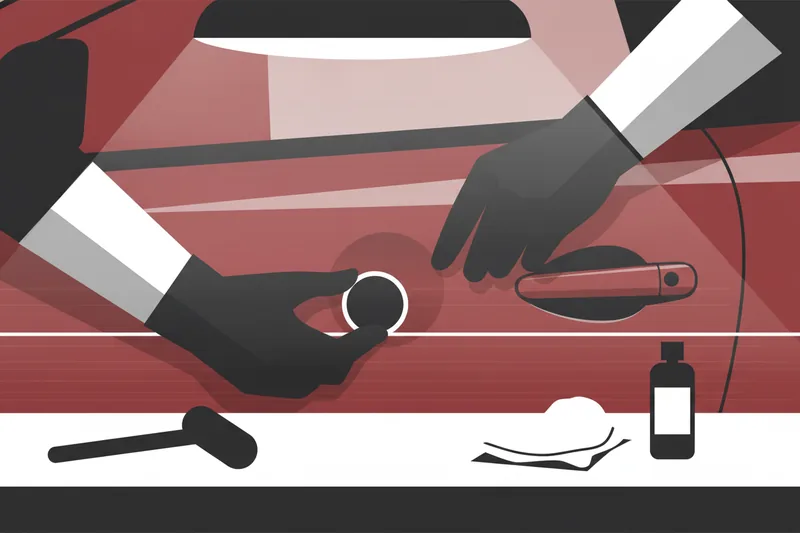
Hot glue and cold glue both pull sheet metal through a bonded tab, but they behave differently enough that picking one by habit rather than by job is where pushmarks, failed bonds, and wasted cycle time come from. For most controlled, repetitive, finish-sensitive paintless dent repair work, cold glue is the stronger default; hot glue keeps a real edge on pinpoint deep dents, very cold shops, and quick low-stakes pulls where its lower setup cost matters more than reusability.
Short answer: which adhesive wins, by job scenario
For hail panels, repeat pulls, and jobs where you need to match tack to the shop's actual ambient temperature, reach for cold glue — a reusable, product- and scenario-specific compound worked on a tab by hand, without a gun or open heat. Hot glue — a heated thermoplastic melted through a glue gun onto the tab — still has its place on deep, sharp micro-dents and single quick fixes. Neither is "the" industry standard: the two serve different functional scopes rather than one simply replacing the other. Where backside access is blocked, both exterior hot-melt and cold glue are candidates, and the real decision is gated by the panel's finish, the specific product, and any OEM restriction — not a blanket rule.
The criteria that actually matter when choosing a PDR adhesive
Six things decide which adhesive belongs on a given job, and both methods have to be judged against each one, not against a reputation.
Bond strength and control during pulling go together: how much force the tab-to-panel bond carries, and how predictably that force moves into the dent center rather than letting the tab walk. Properties here are product-specific — gun, glue, and tab have to be matched for hot-melt systems, and cold glue is an established category but not a standardized chemistry, so tack and stiffness vary by product, not by "cold glue" as one material. Dent size alone doesn't settle any of this either: depth, sharpness, stretch, and backside access weigh more than diameter.
Pushmark risk — a small reverse bump left where metal was pushed past the panel's original line — and paint-damage risk climb on a panel that's been refinished before. That's not an automatic disqualifier, but it carries less predictable risk of cracking or delamination and needs a product-specific compatibility check before you glue-pull it.
Tack time (how long you wait after placing the tab before pulling) and temperature sensitivity are linked: ambient shop temperature changes how fast a compound grabs and how it behaves under load. Reversibility and cleanup round it out — what's left on the panel and in the gun after the pull, and whether the compound can be reused.
None of this makes one method the standard: hot-melt adhesive is a broad-scope exterior attachment system, and cold glue is a more product- and scenario-specific one — a difference in functional scope, not a popularity contest. Worth separating out while you're reading data sheets: panel adhesive, the structural bonding compound used in body construction, is not PDR pulling adhesive at all.
Where cold glue outperforms hot glue
Cold glue's advantage shows up most on hail jobs and other repetitive-pull work. Because it's a reusable, putty-like compound rather than a melted adhesive, there's no gun to keep hot and no cool-down between pulls — it peels off the panel and goes back onto the tab for the next dent with zero residue left behind. That cycle speed is what matters on a panel with dozens of dents to clear.
The same property lowers pushmark risk: you're not managing a bond that's setting and cooling as you work, so there's less chance of the tab shifting mid-pull or of heat transferring into the paint film. Cold glue is also the better match for large shallow dents and heavy hail damage, as well as working a design crown or a damage crown, where spreading a controlled pull over a broad area matters more than pinpoint force.
Temperature-matched tack is the third edge: a compound chosen for the shop's actual ambient range holds its working consistency instead of fighting the technician for it. None of this makes cold glue a universal upgrade, and there's no required sequence — running hot glue first and cold glue second, or the reverse, isn't wrong, because no such order is fixed.
Where hot glue still holds an edge
Hot glue isn't a lesser method waiting to be phased out — it remains a current, indicated technique in its own right, capable of rock-solid adhesion and real pulling force on stubborn damage, which is why calling it simply weaker or less controlled than cold glue misses the point.
It earns its edge on deep, small, sharp dents, where pinpoint pulling power matters more than broad coverage. A common shop workflow runs cold glue first for fast, large-area movement, then finishes with hot glue on the tight spots cold glue can't reach as precisely. It also makes sense when there's no usable backside access and getting it would mean disproportionate removal-and-install work, when the exterior pull direction better matches how the metal needs to move, or when the repair needs controlled tension combined with crown management.
Cost is the other factor: a glue gun and hot glue sticks are a lower upfront outlay than a cold-glue system, which matters for a shop running occasional, low-stakes pulls rather than hail volume. And because cold glue's tack is tied to its rated ambient range, a genuinely cold bay can push a compound outside its intended window — a heated hot-melt bond, which brings its own heat to the panel at application, keeps a practical edge there.
Which adhesive to choose for your repair scenario
Match the adhesive to the job, not the other way around. Hail panels with dozens of repeat pulls favor cold glue for the cycle-time and pushmark reasons above. Shops working in genuinely variable ambient temperature need a compound rated for that swing — a product selection question, not strictly a cold-versus-hot question. Quick, low-stakes fixes with no hail backlog are where hot glue's lower setup cost and single-pull convenience still make sense.
Whichever method you run, confirm compatibility across the whole chain before you pull: the finish with your cleaner, release agent, and adhesion promoter; the adhesive with the glue gun; the adhesive with the tab; the tab with the panel; the tab's neck with the adapter; and the adapter with the puller. Prep, promoter, and release are three separate jobs even when one product handles more than one of them.
There's a finish-preservation argument behind glue pulling generally: I-CAR has noted that glue-based pulling can preserve the exterior coating and backside corrosion treatment better than weld-on pulling — though that's a process advantage, not a guarantee any given adhesive will bond to a particular finish. And no method should be the default just because backside access is missing: glue pulling is one candidate, chosen against the finish, the geometry, and the repair plan, with no fixed order between cold glue and hot glue.
Other alternatives as reference points: epoxy and cyanoacrylate
Epoxy and cyanoacrylate (super glue) turn up in general automotive bonding, but they're structural or semi-permanent adhesives, not PDR pulling adhesives — built to stay bonded rather than to release cleanly for a controlled pull and a reused tab. They're a useful reference point for understanding why PDR adhesives are their own category, not options for a glue-pull job.
Temperature-rated cold glue performance by range
Cold-glue compounds are typically sold in temperature-positioned variants — one spec'd for use up to around 30°C ambient, with a separate warm-weather formulation for conditions above that, rather than one compound simply warmed by the technician to cover both ranges. Exact figures are published per product, not per category: a boundary printed for one variant in a lineup doesn't carry over to a different formulation in the same family. On the hot-glue side, spec sheets describe ambient operating ranges too — one lists -15°C to 30°C — and that number is the usable ambient window, not the glue gun's melt temperature, panel temperature, or a paint-safe limit. Whatever the published range, actual performance also tracks cleanliness and storage condition, not temperature alone, and cold glue stays reusable within those limits without being a structural adhesive.
If you're moving a hail-volume or precision-pull operation from hot glue to a temperature-matched cold-glue system, Glexo builds professional-grade cold-glue lines around exactly that scenario-driven decision.