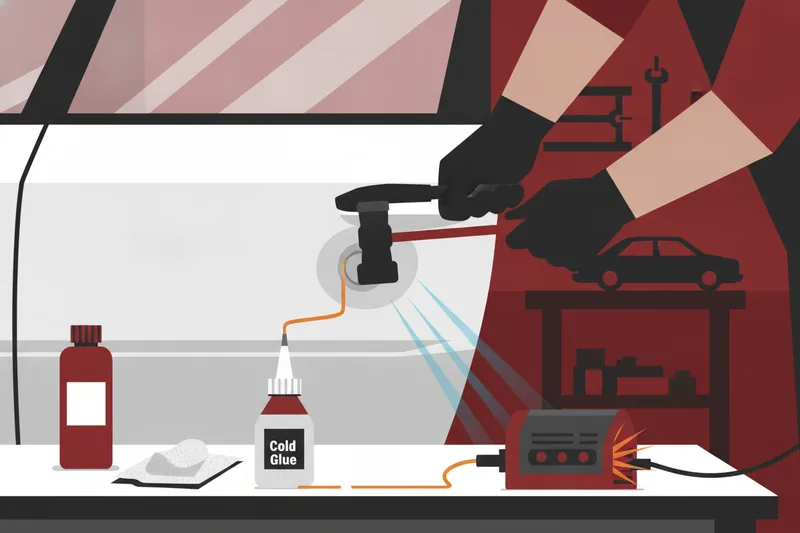
Hot Glue Dent Puller Kits vs Cold Glue Systems: What Actually Works for Professional Dent Pulling
A car dent repair kit glue gun can pull a small, shallow dent under the right conditions, but it isn't built for consistent, repeatable results on volume work. The thermoplastic adhesive that bonds the tab to the panel is sensitive to ambient and panel temperature, and a weak or uneven bond can let the tab slip mid-pull — risking a stalled pull, a re-glue, or a pushmark on the finish you were trying to protect. Professional cold-glue tab-and-slide-hammer systems solve that reliability problem differently: a reusable pulling compound and a steel-head slide hammer give a technician more control over tack and timing, pull after pull, which is why shops doing hail work or daily glue-pulling lean on them instead of a hobbyist glue gun.
What a Glue-Pull Dent Repair Kit Is and How It Works
A glue pulling dent repair kit is built around one idea: bond a small attachment point to the dent, then pull on that point until the metal returns to its original plane. It's one branch of paintless dent repair (PDR) — correcting a panel's shape without sanding, filling or repainting, by applying controlled pressure or pull instead. Consumer kits sold as a car dent repair kit glue gun combo usually bundle three parts: a hot glue gun, glue tabs and a slide hammer, sometimes with pulling rods or a small bridge accessory thrown in.
The hot glue gun heats a glue stick — a thermoplastic adhesive rod — until it's molten, then deposits it onto a glue tab, a shaped plastic disc or strip pressed onto the dent's lowest point. The adhesive cools and sets, bonding the tab to the paint. A slide hammer — an inertial pulling device with a sliding weight on a shaft — threads onto that tab, and short, sharp strokes of the weight transfer into a pulling force. For damage too broad for one pull point, some kits add a dent lifter bridge: a frame spanning the repair area that lets the pull come from a supported central point, in the same spirit as the bridge pullers used in professional shops.
It's worth separating this from a term buyers sometimes see attached to similar equipment: Glue Pull Repair, or GPR. Some industry training programs describe GPR as a conventional panel-straightening technique that borrows the glue-and-pull idea from PDR but applies it as a structural or cosmetic repair method, not necessarily a paintless one. The name alone doesn't declare the finished panel paintless, and it isn't interchangeable with the glue-pulling technique used inside full PDR work. If a listing calls itself a GPR kit, that tells you about the repair approach it targets — not whether it will deliver a true paintless result on your panel.
The precise technique — how long to let the glue set, the rhythm of the pulls, reading the panel as you go — deserves its own walkthrough; what matters here is the mechanism behind the kit itself, and once the shape is restored, finishing often involves a further pass with tools such as sonic tips or a blending hammer, depending on what the panel needs.
Hot Glue vs Cold Glue: The Trade-Off That Decides Reliability
The difference between a hot-melt glue gun kit and a professional cold-glue system comes down to three things: tack strength — how strongly and how fast the adhesive grabs, how much that grip depends on temperature, and what happens to the panel when the bond doesn't hold.
Hot-melt adhesive is applied molten and needs to cool before it reaches full tack, which puts the clock and the room temperature in charge of the pull. It also has real strengths: a properly set hot-glue bond can deliver high pulling force, which is why technicians still reach for it on deep or sharp dents that need pinpoint force rather than broad movement. Cold glue works differently — it's a ready-to-use, reusable tacky or viscoelastic compound applied directly to a tab, with no gun or melting stage involved. That removes the heating-and-cooling variable from the pull, but it doesn't make cold glue immune to conditions: its performance still depends on ambient temperature, surface cleanliness and how it's been stored, which is why professional lines are typically formulated and sold in temperature-specific variants rather than one compound for every shop and season.
Neither method is simply better. Selection depends on the damage, the finish, the day's temperature, the tab and pulling interfaces in play, and the repair plan the technician has already settled on. There's no fixed rule that cold glue goes first and hot glue finishes the job, or the reverse — order follows the repair, not the adhesive. What does change between the two in practice is risk on repetitive work: a hot-glue bond that's under-cooled, contaminated or pulled too early is more likely to slip or release mid-pull, and a slipped pull on a shallow dent is exactly the scenario that produces a pushmark instead of a clean lift. A cold-glue system, pulled correctly, gives a technician a more predictable grip to work from — which matters more on a hail roof with eighty dents than on a single door ding.
Surface Prep and the Features That Separate Consumer Kits from Pro Systems
No glue, hot or cold, bonds reliably to a dirty panel. Surface preparation is chemical, not abrasive: wiping the repair area with isopropyl alcohol or a PDR-specific cleaner to strip wax, ceramic coating, sealant and road film, each of which acts as a release layer and cuts adhesion before the tab ever touches the paint. Sandpaper or a matting sponge has no place here — either one damages the clearcoat and defeats the point of a paintless repair. It also helps to keep three jobs separate, even when one product handles more than one: cleaning the surface, promoting adhesion, and releasing the glue afterward are three different functions, and a kit that only covers one of them hasn't covered prep on its own.
This is where consumer glue-gun kits and professional systems start to diverge beyond the adhesive. A bundled starter kit typically ships a gun, a hammer and an assortment of tabs sized to fit as many dents as possible — reasonable for an occasional door ding, less so once real damage is behind it, because tab shape, panel curvature and pull direction all need to match the actual low for the pull to work, not just whichever tab happens to be in the box. Professional buyers tend to check tab compatibility before anything else: whether the tab's neck and interface actually fit the puller or adapter already on hand, since a mismatch either won't transfer force cleanly or risks damaging the attachment point.
The slide hammer itself carries a feature that's easy to miss on a budget kit: head material. A steel head is the standard choice for tab-pulling systems built around repeated impulse strokes; an aluminum head is generally the weaker choice under that kind of repetitive impact loading, and it matters more the more pulls a hammer sees in a shift.
Hail damage repair is where all of this compounds. A hail-damaged roof, hood or decklid can carry dozens to hundreds of dents of varying size, and working through that volume needs tabs and glue that hold up pull after pull without refreshing the adhesive every few minutes — not a kit sized for a single ding. Before committing any adhesive system to a refinished panel, a wrap, PPF or a ceramic-coated finish, the coating itself needs a case-specific look, since these surfaces don't all respond to glue and release products the same way.
How to Evaluate a Kit and Avoid Common Pull Failures
Evaluating a kit well starts before you look at what's in the box. The common mistake is picking a pulling device first and working backward — choosing a hammer or a bridge because it's included, rather than because it matches the dent. Match the device to the pull instead: a mini lifter for a controlled, localized lever pull; a bridge or beam puller for a sustained pull with support around the repair; a slide hammer for a fast impulse pull; a T-handle puller for a manual, aligned pull on an accessible dent. Tab choice follows the same logic — size and shape to the low, panel curvature, how much pull area is needed, and whether the tab's neck actually fits the adapter and puller. Before buying into any kit, it's worth confirming that every link in that chain — cleaner to finish, adhesive to gun, adhesive to tab, tab to panel, tab neck to adapter, adapter to puller — is actually compatible.
Failure in the field usually shows up one of three ways: the adhesive fractures, it releases from the tab, or it releases from the finish — and the fix for each is different, so repeating the same pull without figuring out which one happened just wastes a cycle and risks the paint. Overloading a bridge or beam puller creates its own failure mode: too much force produces a high right at the tab instead of a lifted dent, or new lows at the support feet. Either way, the result reads as a pushmark — a small stress bump left behind by an overcorrected or poorly adhered pull — rather than a clean repair.
With that in mind, here's how the hot-glue kits actually marketed for this job compare:
- Trifecta Glue gun — a hot-melt glue gun positioned as an upgraded tool aimed at serious PDR use rather than a casual hobby kit; worth a look if you're staying in hot-glue pulling and want more input than a generic import.
- Super PDR — the roughly $70 paintless dent removal kit sold on Amazon that most budget comparisons measure against; fine for learning the motion on a door ding, not built for pull-after-pull consistency.
- Master Glue Kit - Collision & PDR 105 Piece Kit — bundles a 110V glue gun, a T-handle slide hammer, assorted tabs and pulling rods into one box; convenient as an all-in-one starter, still a consumer-grade hot-glue system underneath.
- JMgist Paintless Dent Removal Puller Kits — an entry-level hot-glue kit aimed at hail and door-ding repair; workable occasionally, not sized for daily volume work.
Past the occasional-ding stage, the gap between any of these and a cold-glue tab system built for repeat use is the same trade-off covered above: tack that doesn't depend on a cooling cycle, and tabs and compound sized for dozens of pulls in a row rather than one.
FAQ: Hot Glue Dent Pullers, Answered
Can a hot glue gun actually pull a dent? Yes, within limits. A properly set hot-melt bond can produce strong adhesion and real pulling force on a stubborn dent, and the pull travels through a straightforward chain — pulling device, adapter, tab, adhesive, finish, panel skin. It's a genuinely useful method when there's no usable access to the back of the panel, or when an exterior pull better matches the direction the metal needs to move. What it doesn't give you is temperature-independent consistency, pull after pull, which is the gap cold-glue systems are built to close.
When should I upgrade to a cold-glue system? Once glue-pulling stops being occasional. A shop running hail volume, or any technician pulling dents daily, needs adhesion that behaves the same way on the fortieth tab as it did on the first — without re-gluing, waiting out a cooling cycle, or fighting the day's temperature. That's the point where a reusable cold-glue tab system earns its cost back in fewer failed pulls and faster cycle time.
For a shop working through hail damage at volume, a kit built specifically around that workload — like the Hail Kit, which pairs metal tabs with a cold-glue compound suited to hail work — avoids re-gluing between every pull. For a technician doing a broader mix of daily dent work rather than hail exclusively, a general-purpose tab set such as the Full Set v2 paired with a cold glue matched to the shop's working temperature range gives the same pull-after-pull consistency without being limited to one dent size or shape.
If you're evaluating glue-pull equipment for regular, professional use rather than the occasional ding, the decision point is adhesion you can count on across a full shift and a full range of shop temperatures — not whichever glue gun happens to be cheapest online. Glexo builds cold-glue adhesion systems and surface-prep products for exactly that kind of volume PDR work, so explore its professional cold-glue dent-pulling systems built for consistent, repeatable adhesion across working temperatures before you commit to another hot-glue kit.