What Is Paintless Dent Repair (PDR) and How Does It Work?
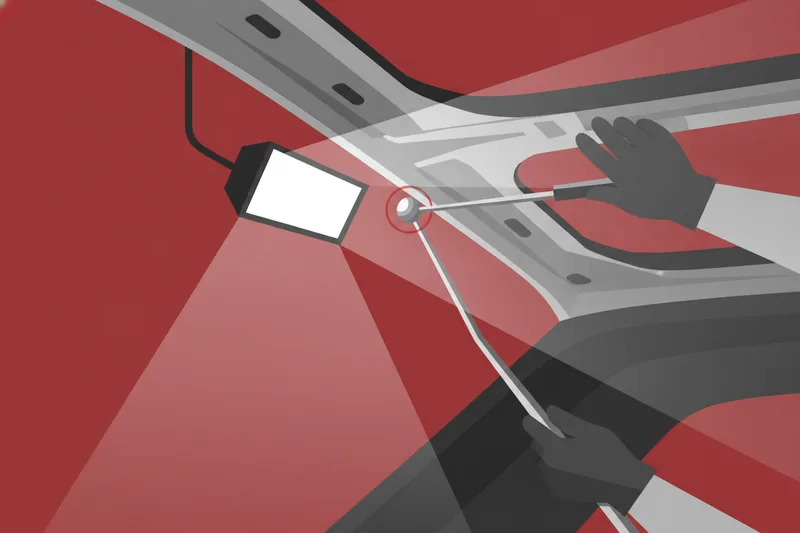
Paintless dent repair, or PDR, restores a dented panel by manipulating the metal back toward its original shape rather than filling and repainting the damage — a process often referred to in the trade as PDR dent removal. A technician gets controlled access to the panel — from behind, through an existing opening, or from the front using a temporarily bonded pulling point — and moves the metal in small, deliberate steps until the surface reads correctly under a reflection board. Because the repair acts on the metal and leaves the existing finish in place, the panel keeps its factory paint, provided the damage and the paint itself qualify for the method, which has real limits.
What Paintless Dent Repair Actually Means
PDR is a group of professional methods that restore the shape of an exterior metal panel through controlled movement while keeping the panel's existing, serviceable finish in place, rather than stripping and reapplying it. That is what "paintless" refers to: the outcome and the repair path, not a promise that no material ever touches the car. Cleaning agents, release products, and in some cases an adhesive pulling point are part of ordinary PDR work, and none of them put the job outside the paintless category. What does put a job outside it is anything that changes the finish layer itself — sanding has no place in a paintless process, and a result that still needs filler or refinishing is not classified as full PDR, however much the shape improved. It is also worth being precise about what the name promises: PDR restores contour, not the literal disappearance of every trace of damage on a panel that has already cracked or creased.
The Physical Principle Behind the Repair
The principle underneath PDR comes down to how sheet metal responds to being bent within its elastic range: residual stresses and the metal's plastic-strain history create a tendency for it to spring back toward its original shape, and a technician's job is to encourage that return in a controlled way rather than force it in one motion. In practice this means a sequence of small, calculated movements — a push from behind, a pull from the front, a light tap to settle a remaining high spot — each checked against reflection before the next is made. There is no fixed order that applies to every dent: a plan that starts at the center on one panel and works from the outside in on another isn't a rule being broken, it's two different damage patterns calling for two different approaches. The broader repair plan a technician builds organizes that work; it is not a template for how the metal itself must move, since the actual pushes, pulls and tool changes are decided by how that specific panel responds. Reading the panel correctly under proper lighting and reflection, and confirming the part and its repair constraints before starting, matters as much as any striking or pulling technique. Technical feasibility — whether a piece of metal can be moved — and repair authorization — whether that move should be made — are separate judgments, and a technician makes both together as the work proceeds.
Two Conceptual Approaches: Access-Based Manipulation and Glue Pulling
Every PDR technique falls into one of two conceptual families, distinguished by how the technician reaches the metal. Access-based manipulation works from the panel's backside: through a factory opening, after removing a trim piece, or via another authorized route, the technician pushes the metal from behind using rods and bars, guided by reflection. Glue pulling works from the front instead: a tab is temporarily bonded over the dent with a hot-melt adhesive or a cold-glue compound, and a pulling device attached to that tab draws the metal outward.
Neither approach is a default, and neither replaces the other. Whether backside pushing or glue pulling is the better starting point depends on the specific damage, the access available, and the finish condition together, not on access alone. Glue pulling earns its place specifically where that backside access is missing or would cost more in disassembly than the repair is worth, or where an exterior pull actually matches the direction the metal needs to move. The reverse holds too: lacking backside access doesn't make glue pulling the obvious answer by default — it still depends on whether the finish and the damage geometry support bonding a tab to that surface. Within glue pulling, the pulling device matters as well: a slide-hammer impulse and a sustained pull from a lifter or beam produce different control profiles, and a pull that isn't aligned with the dent can shift the surrounding area instead of fixing its center.
A Typical PDR Scenario in Plain Terms
Two damage patterns show the method clearly. Hail damage is dozens to hundreds of small dents of varying depth, spread mainly across the roof, hood and decklid — the horizontal panels that take the brunt of the impact. A door ding is a different pattern: a single, isolated dent from a car door or a shopping cart, usually shallow and round, though the same dent can also involve a sharp crease or sit along a body line depending on how it happened.
In both cases, the sequence a technician follows is a planning tool, not a fixed script. They may work a dent down in stages, return to a broader pass across the panel, or revise the approach entirely based on how the metal responds, rather than following one predetermined order from rough movement to finish. Before any of that starts, the technician identifies the part and whatever repair constraints apply to it — a step that comes before metal work, not after. Both scenarios illustrate the same underlying logic, but they aren't interchangeable: what makes PDR a realistic option for a given hail dent or door ding is a judgment based on that specific panel, not a guarantee that applies to dents in general.
How PDR Differs From Filler and Repainting
Traditional dent repair works on the surface: sand the damaged area, build it back up with body filler, prime it, and repaint to match. PDR works on the metal instead, and when it succeeds fully it needs none of that — filler isn't a secondary ingredient of paintless repair, it's the thing the method is defined by avoiding. That distinction is also the line used for classification: a result counts as full PDR only when exterior filler and refinishing aren't required and the existing finish remains intact; other steps, such as removing and reinstalling a part, corrosion protection, or a sensor scan, don't change that classification, but filler and refinish do. If a technician finds during the job that filler already exists under the paint, that finding escalates the case: it moves outside the paintless category and the repair plan has to be reconsidered from there. Push-to-paint, where metal is straightened before the panel still gets primed and painted, is a related and legitimate workflow, but it isn't a paintless outcome in the way PDR is. Filler under the surface also changes how the metal responds to pushing and pulling, which is part of why a technician treats it as a different job rather than a continuation of the same one.
Where PDR Stops Being the Right Fix
PDR works within a window, and several conditions sit outside it. A sharp, creased fold concentrates stress into a narrow line that resists the gradual, controlled movement the method depends on, and the same is true of metal that has been stretched beyond its ability to spring back — both call for a different plan, not more force with the same tools. Cracked paint and edge damage near a flange or hem raise the risk that working the metal will make the finish fail outright, so the paint's own condition is part of the assessment before any pulling starts. A dent sitting on or touching a prior repair, including hidden filler, carries that same risk and usually means stepping back to reassess rather than continuing on the original plan.
None of this is only a technical question. A technically movable dent can still be the wrong job to take on paintless terms when the access needed to reach it, or the time it would take to do properly, outweighs what the repair is worth — at which point converting to a push-to-paint approach, or handing it to a conventional repair path, is the sound call rather than forcing a finish that isn't achievable. Knowing when to stop pulling and change the plan is part of the craft, not an afterthought.