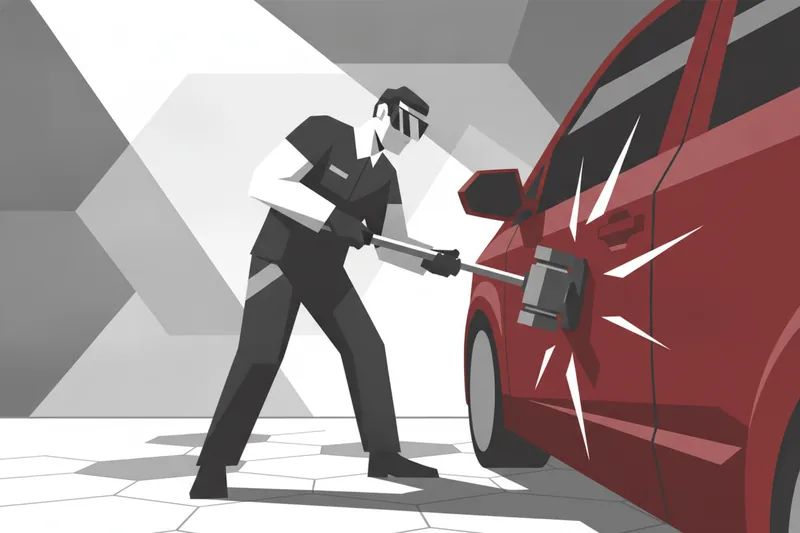
Slide Hammer Pullers for PDR: Choosing the Steel-Head Tool That Works With Glue Tabs
A slide hammer puller for paintless dent repair is a steel-head inertial puller sized and weighted to work with a glue tab, not the aluminum-finish, axle-grade tool that dominates generic "slide hammer puller" search results. The distinction that matters isn't brand or price — it's head material, shaft weight, and whether the hammer's working end is built to carry a tab and cold glue instead of a hook or threaded axle adapter. Get those three right and the hammer disappears into the technique; get them wrong and it either damages the panel or tears the tab loose mid-pull.
What a PDR Slide Hammer Puller Is — and How It Differs From Axle, Bearing, and Hub Pullers
A slide hammer is, mechanically, an inertial pulling device: a shaft with a sliding weight that the user throws toward a stop at the handle end, converting that momentum into a sharp pulling impulse at the working end. What sits at that working end is what separates a PDR tool from everything else wearing the same name.
Search "slide hammer puller" and most results are built for driveline and bearing work — a tool like the Maddox Slide Hammer, sold through Harbor Freight to pull Jeep axles, or a kit such as the KFFKFF Inner CV Axle Puller Tool Set, built around a 5/8 in-18 slide hammer paired with CV joint adapters. These are sized to break a press fit between metal parts: heavier swinging weights, larger threaded ends, and no provision for carrying a bonded glue tab.
A PDR dent puller does the opposite job. The panel it's pulling is thin sheet metal, not a pressed bearing race, and the thing transferring force isn't a steel hook but a glue tab bonded to the dent center. The hammer has to deliver a controlled, repeatable impulse that a technician can read and stop on — not maximum separation force. That's the real line between "slide hammer puller" as the market sells it and what a PDR panel actually needs.
Steel Heads vs Aluminum, and the Weight That Gives You Control
Head material is the first filter. For glue-tab work, the hammer's head needs to be steel; aluminum-head versions aren't recommended for this use, since they're built for a lighter-duty job than absorbing repeated sharp impulses against a bonded tab. A steel head holds up to the kind of repetitive pulling a dent session — or a full hail panel — puts it through, where a softer head risks wearing or deforming at the point it takes impact.
Weight is the second filter, and it works against the instinct to buy the heaviest tool available. A PDR slide hammer isn't trying to snap a press-fit axle free in one throw; it's delivering a series of short, sharp impulses that a technician reads and adjusts between pulls. A hammer on the lighter side of the market — the exact weight varies by hammer and use case, but it generally sits well below the heavier mechanical-puller builds meant for hubs and bearings — gives better control over how far the metal moves on each throw and puts less strain on the wrist over a long session. Weight balance along the shaft matters too: how the moving weight distributes between handle and head affects how predictable each impulse feels, which is part of why technicians tend to settle on one hammer and stick with it rather than switching models mid-job.
Tab Compatibility, Cold-Glue Fit, and the Correct Working Order
None of this matters if the hammer can't carry a tab. The working end needs a tab adapter — the interface between the glue tab and the pulling device — sized to the industry-standard thread or stud most glue-tab systems use, so the technician isn't locked into one tab brand because of the hammer they bought.
Cold glue itself is usually a reusable tacky or viscoelastic compound applied to the tab face, with performance that depends on temperature, surface cleanliness, and how the glue has been stored — most systems offer a formulation for everyday ambient temperatures and a separate one for hot-weather work, so the glue gets matched to the job, not the other way around.
Working order matters as much as the hardware. The tab goes onto the slide hammer first — fixed and secured — before any glue touches it. Only then does the technician heat the tab if the glue calls for it, apply the cold glue, and screw the assembled tab onto the dent center to pull. Gluing the tab to the panel before it's seated on the hammer is a sequence to avoid: an unsecured tab can let the hammer jump free mid-pull and mark the panel.
For a hail shop running pull after pull across a roof or hood in one sitting, durability at the shaft-to-handle joint becomes its own selection criterion — a one-piece shaft and handle, the kind noted on the Performance Tool W2015P Compact 15 oz. Slide Hammer Dent Puller for auto body work, has fewer joints to work loose under that kind of repeated inertial load than a hammer assembled from separate threaded sections.
Choosing Your Slide Hammer and Pairing It With a Glue-Tab System
Two decisions do most of the work.
Steel-head slide hammer, industry-standard build: the reasoning is durability under repeated glue-tab pulls. A steel head keeps its shape and its grip on the tab adapter through a full day of pulling where an aluminum head risks wearing down faster than the job calls for — the same logic behind a one-piece shaft design like the Performance Tool W2015P's, built for strength rather than raw mass.
Mid-weight slide hammer, roughly in the lighter end of what the market sells rather than the heavy builds meant for axles and hubs: the reasoning is control, not force. A technician pulling a panel needs to feel each impulse and stop at the right moment; a hammer sized for breaking a CV joint free makes that much harder to judge.
Once those two boxes are checked — steel head, controllable weight — what decides the rest is whether the hammer's working end takes a standard tab adapter cleanly, so it runs with whatever glue-tab system the shop already stocks.
For a shop running volume hail work, a kit like the Hail Kit suits the pace of repeated pulls, while a technician doing lighter panel or door-ding repairs is better served by the smaller Mini Set v2. Where the finish or ambient heat calls for it, Cold glue DIABLO is an alternative cold-glue compound worth having on hand.
Glexo's PDR tab and cold-glue systems are built around that same standard: the tabs fit industry-standard steel-head slide hammers, so the hammer stays a hammer and the system around it is what does the rest of the job. Explore Glexo's PDR tab and cold-glue systems built to work with industry-standard steel-head slide hammers.