PDR Glue Gun Guide: Hot vs Cold Glue Systems
There's no single best PDR glue gun — the right setup is whichever combination of gun type, glue formulation and tab holds up at your shop's actual working temperature and pull volume. A hot-melt gun paired with a glue stick built for the wrong season, or a cold-glue compound rated outside your shop's temperature range, both fail the same way: tabs that let go mid-pull, or adhesion too slow to keep pace with a hail job. Picking correctly starts with understanding what each system does and where it breaks down.
What a PDR Glue Gun Is and How It Holds a Pull
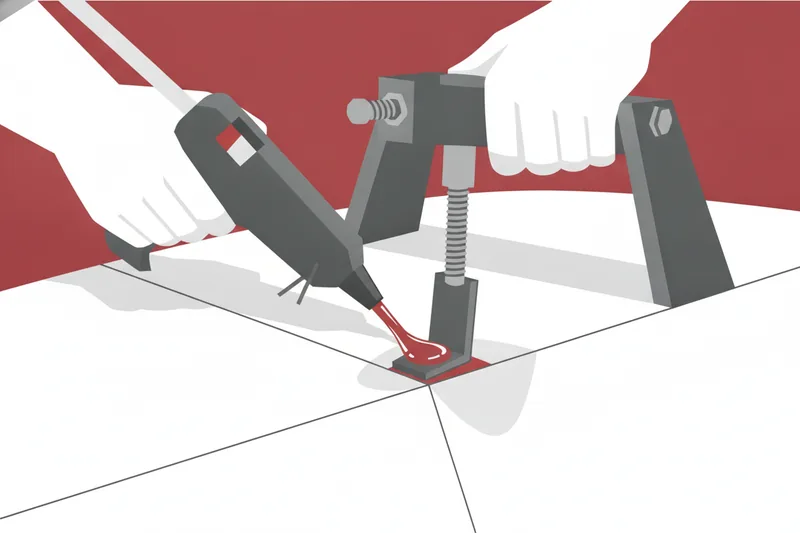
A PDR glue gun is the tool that heats and dispenses hot-melt adhesive onto a glue tab, which is then bonded to a suitable exterior finish so a compatible pulling device can draw the dent back into shape. Cold-glue systems skip the glue gun: a reusable tacky compound is pressed onto the tab's face by hand, though Glexo's instructions call for warming the tab with a heat gun to about 70°C/160°F first.
Either way, the tab itself does no pulling. It's an external attachment, not a suction cup, and can't generate force on its own. Once the adhesive bonds the tab to the panel, a slide hammer, bridge puller, mini lifter or T-handle puller applies controlled pull through that attachment point, moving the metal toward its original contour.
This is what separates glue pulling from backside pushing: the technician works the dent entirely from the outer surface, using the glue bond as the only contact point. That makes bond quality — strong enough to hold the pull, controlled enough to release cleanly afterward — the whole game. Choosing between hot and cold systems, and between glue formulations, comes down to what keeps that bond reliable in your shop's conditions.
Hot Glue Guns vs Cold-Glue Systems: The Core Tradeoffs
A PDR glue gun heats a thermoplastic adhesive stick to its melting temperature and dispenses the PDR hot-melt adhesive onto the tab in liquid form; the bond forms as the adhesive cools and sets against the panel. That gives hot-melt adhesive strong, high-force adhesion suited to stubborn or deep dents, but it comes with timing demands: the gun needs a warm-up period before the adhesive reaches working temperature, and the technician has a short window — the glue's tack time — to position the tab before it sets. Too slow and the bond is weak; too fast and the tab shifts.
Cold-glue systems remove that timing pressure. The compound is tacky at room temperature, goes onto the tab without being melted in a glue gun, and is usually reusable: after a pull it peels back off and can be reapplied. That reusability suits repeated pulls across a large hail job when the repair plan and shop conditions call for it, since reloading a hot-melt gun on every tab takes extra time.
The tradeoff is precision. Cold glue handles broad, initial movement well but lacks the pinpoint pulling power hot glue delivers on small, sharp, or deep damage. Many working repairs use both in the same job — cold glue to rough out a panel, hot glue to finish a stubborn low — and there's no fixed sequence that applies to every repair; the damage and the repair plan decide the order.
Temperature sensitivity cuts across both systems. A hot-melt bond's set time shifts with ambient and panel temperature even though the stick melts to a fixed point, and cold glue's tack and flow depend directly on how warm or cold the shop is. Neither is simply better than the other — they're different tools for different stages of the same repair.
Corded vs Cordless Glue Guns for Mobile and High-Volume Work
A corded glue gun draws continuous power, so it holds a steady melting temperature through long runs without worrying about charge level — useful in a fixed bay doing back-to-back hot-glue pulls. The cord is the limitation: reach is fixed, and moving between vehicles or around a large panel means managing the lead.
A cordless, battery-powered glue gun trades that steady power for mobility. For a mobile tech working a lot full of hail-damaged vehicles, or anyone moving constantly between panels, not being tethered to an outlet speeds up the job. Some cordless guns run on dedicated battery packs built for the tool; others are designed to share batteries with an existing power-tool platform, which can mean fewer chargers to carry and batteries that do double duty with other shop tools.
Power draw on professional cordless guns varies by model; check the manufacturer's power spec for the gun you're considering, enough to keep a glue stick at working temperature between pulls, but worth checking against how many tabs you expect to set per charge on a busy day. For high-volume work like a hail queue, that usually means carrying a spare battery or keeping a corded backup gun on hand rather than stopping to recharge mid-shift.
There's no single configuration that's standard across the trade — the right call depends on whether your work is mostly stationary or constantly moving, and how many pulls you need to get through before the gun, or its battery, needs attention.
Matching Glue Formulation to Ambient Working Temperature
Glue formulation needs to match the ambient working temperature in the shop or on site — not the temperature of the panel itself. A cold-glue compound rated for up to about 86°F (30°C) ambient is built and tested for that upper boundary, though the lower limit varies by product; push it well above and tack behaves differently than the product was designed for.
Above that upper boundary, the right move is a separate warm-weather variant built for the heat, not the standard compound heated up by hand. Published ranges aren't consistent across every product line, either — a hail-focused or precision compound may not carry the same stated boundary as a standard formulation, so always check that compound's own label, since limits vary by product.
Tack time behaves differently across that range because cold glue's flow isn't uniform under load: compounds can feel stiffer under a quick pull and softer under a slow sustained one, and that balance shifts with ambient temperature and differs by product line. Shop temperature, cleanliness and storage conditions all affect which behavior you actually get on a given day.
Hot glue isn't temperature-proof either. Glue sticks come in formulations built for cold or hot working conditions, sometimes distinguished by color, because ambient temperature changes how fast the melted adhesive sets on the panel. A stick that tacks quickly in a cool bay may stay workable too long in a hot one, so the stick needs to match the room, not just the gun's thermostat.
Removing Glue Residue After a Pull
Cold glue is largely self-cleaning: a compound in good condition peels off the panel and goes straight back onto the tab for the next pull, typically leaving no residue on the paint. How well it releases, and how much life it has left, depends on more than how clean the panel was — tab area and shape, compound thickness, ambient and panel temperature, how long it sat before the pull, pull rate and direction, which pulling device was used, and how many cycles that batch of compound has already been through all affect how it behaves on the next job.
Hot-melt bonds need a deliberate removal step. A dedicated glue release product breaks the bond without attacking the clearcoat — a different product from the surface cleaner used to prep the panel before gluing, and different again from any adhesion promoter, even where one product is formulated to do more than one job. Before relying on a release product, confirm it's compatible with the panel's actual finish, the same way you'd confirm an adhesive is compatible with the gun and a tab is compatible with the panel.
Panel-safe handling means following the release product's instructions rather than reaching for a blade or scraper — metal tools lift clearcoat and plastic trim just as easily as they lift glue. Once the bond releases, a quick check for leftover tack before moving on to finishing work saves a callback.
Choosing the Right Glue System for Your Shop
Once gun type and glue formulation are matched to your conditions, four criteria separate a system that holds up from one that causes callbacks.
Consistency and tack time. A compound or stick that performs the same way pull after pull, shift after shift, is worth more than one with marginally higher peak strength that varies by batch or temperature. Tack time should match your pace: too slow and you're waiting between tabs on a hail job, too fast and you lose the chance to reposition.
Tab compatibility. The chain that actually carries the pull runs from the pulling device, through the tab and its adapter, through the adhesive, through the finish, and into the panel. A glue system that isn't matched to your tabs — or tabs that don't fit your puller's adapter — breaks that chain at its weakest link, no matter how good the adhesive is on its own.
Portability and battery life. A mobile technician moving between vehicles gets more from a cordless setup with enough runtime to clear a job without a mid-shift charge; a shop doing stationary panel work gets more from the steady output of a corded gun.
Finish-specific caution. Refinished paint, filler repairs, ceramic coatings, wraps and paint protection film each need their own check before committing to a glue plan — what works on factory paint doesn't automatically work on a wrap. When backside access is blocked by double-panel construction, exterior hot-melt or cold glue become candidate approaches, not automatic defaults; confirm against the finish, the product, and current OEM repair information before choosing one over backside pushing.
Matching all four to your actual working temperature and job volume, rather than reaching for one all-purpose gun, is what keeps tab pulls reliable from one repair to the next. From here, the decision comes down to category: a hot-melt gun and stick system for high-force detail work, or a cold-glue compound and tab system built for your shop's temperature range and pull volume.
FAQ: PDR Glue Gun and Glue System Questions
At what temperature should I switch glue formulations? Glexo's standard cold glue is rated to about 86°F/30°C ambient, but that boundary applies to that specific compound, not every product on the market. A warm-weather variant, not a heated version of the standard compound, is the usual answer above that line. A glue gun's thermostat setting isn't the same as ambient or panel temperature, so don't use the dial to judge whether conditions call for a different formulation.
How do you remove glue after a PDR pull? Cold glue peels off the panel and back onto the tab for reuse, usually with no residue. Hot glue needs a compatible release product matched to the finish — the stick's color is a formulation choice, not a cross-brand performance spec.
Is hot glue or cold glue better for PDR? Neither — they're different methods chosen for the damage, finish and repair plan, not a strict upgrade from one to the other, and there's no required order for using them together.
Matching glue gun type and formulation to your shop's temperature range and job volume is what keeps tab pulls predictable instead of a gamble. Glexo's range of PDR glue systems and tabs covers both ends of that decision, so explore the lineup to find the setup matched to your working conditions and job volume.