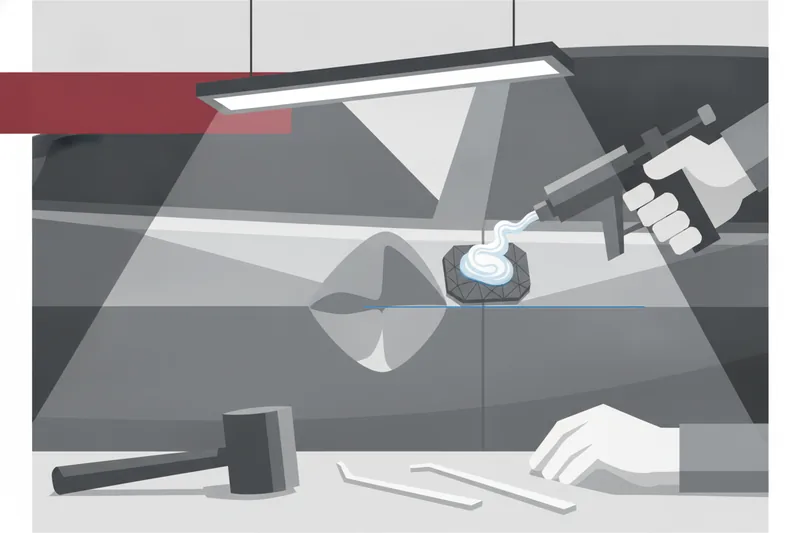
Glexo Cold Glue: How It Works and Which Variant to Choose for Your Next PDR Job
Glexo cold glue is a reusable, tacky pulling compound used in paintless dent repair (PDR) — the technique of pulling a panel back into shape without repainting it. It only delivers consistent tack when a technician follows the order the system is built for: tab fixed to the slide hammer first, glue applied to the tab second, and the assembly screwed to the dent last. Reliable adhesion then comes down to three things: that tab-first working order, heating the tab — never the panel — to get proper tack, and picking the cold-glue variant that matches the day's ambient temperature, with the trade's common dividing line sitting around 86°F/30°C. Skip any one of the three and a shop risks a failed pull, a lost tab mid-pull, or a cracked panel edge.
What Cold Glue Is and Where It Fits Your PDR Workflow
Cold glue in PDR is a single, ready-to-use tacky or viscoelastic compound — meaning it stretches slightly under load before releasing its grip, rather than snapping free — pressed onto a tab to create an exterior pulling point. It isn't a two-part adhesive and it isn't a structural, cold-curing bonding agent. The category isn't owned by one manufacturer either: multiple makers produce cold-glue compounds and matching tab systems for professional technicians, so "cold glue" describes a type of consumable, not one company's technology.
Inside a glue-pull workflow, cold glue earns its place for broad initial movement on larger dents, selected repeated-pull hail jobs, exterior pulling where a hot-melt step isn't part of the plan, and certain large or complex damage. Manufacturers typically split their cold-glue formulations by ambient condition — a standard compound built for everyday shop temperatures, and a separate high-heat formulation for warmer days, which is a distinct product rather than the standard compound simply warmed with a heat gun. A further compound is built specifically for small-contact, precision pulls and hail work. Around cold glue, a PDR consumables line typically spans compatible tabs, surface-prep wipes, blending and knockdown tools, and hot-melt adhesive, giving a shop one place to source its glue-pull consumables.
The Correct Working Order, Heating, and Surface Prep That Decide Adhesion
Why tab-first, then glue, then panel
Before any pull, the fundamentals of the job still have to be checked: controlled lighting to read the panel, an honest look at the damage, finish and access, and any OEM constraints that limit what can be done to that part. Once the repair plan is set, the tab-first working order for a cold-glue pull is the sequence the system is built for. The tab goes onto the slide hammer — an inertial pulling device that delivers a sharp pulling impulse through a sliding weight — first. Glue is applied to the tab second. Only then is the tab-and-hammer assembly screwed onto the center of the dent. Gluing the tab to the panel before it is secured to the hammer risks the hammer jumping free mid-pull and marking or denting the panel further.
Why heating matters for tack
Warming the tab with a heat gun to roughly 70°C/160°F before the glue goes on brings the compound into proper working consistency for a clean bond. That conditioning step is about the adhesive, not the car: it does not extend to heating the panel itself. Panel tolerance for heat varies by metal, coating, and nearby components, so check the OEM repair data for that specific part before adding any heat beyond the tab, and stop if the finish shows any sign of stress. Surface prep decides the rest. Cleaning for a glue pull is chemical only — isopropyl alcohol or a PDR-specific degreaser — never abrasive, since sandpaper or a matting sponge damages the clearcoat and defeats the purpose of a paintless repair. It also helps to keep the roles straight: a cleaner, an adhesion promoter, and a release agent are three different jobs, even when one product happens to do more than one of them. Ceramic coatings complicate adhesion further — they can reduce how well a tab grips, so following the coating manufacturer's own removal instructions is worth doing where maximum adhesion matters.
Choosing the Right Temperature Variant for Your Ambient Conditions
Picking between a standard-temperature cold glue and a high-heat variant is a question of which one stays in its working window at the ambient temperature on site that day, not a question of how hot the panel can safely get. Variant choice manages the compound's tack, not the panel's heat exposure — panel heat limits are a separate call governed by the finish and OEM data for that part.
Splitting compounds by ambient temperature is common practice among cold-glue manufacturers, though formulations and temperature behavior vary by brand and product rather than following one universal standard. The practical habit worth building is checking the actual ambient temperature at the time of the pull — not just the forecast or the season — since conditions near 86°F/30°C can shift through a workday and push a standard-temperature compound outside its intended range.
Cold Glue in High-Volume Hail Repair Workflows
Hail damage typically means dozens to hundreds of dents of varying size spread across the roof, hood, and decklid, and a shop working through that volume needs a process that doesn't stall between pulls. Cold glue isn't the only method in a hail workflow — shops also lean on other tools and techniques depending on dent size and depth — but it carries real weight in repeated small-contact pulls, where a reusable compound on a matched tab keeps a technician moving from dent to dent without re-gluing from scratch each time. A hail-focused tab-and-glue combination, built for high adhesion across many small pulls, is meant to cut down on failed pulls over a long repair day. The adhesion fundamentals don't change at volume — clean, properly prepped tabs still decide how many of those pulls hold on the first try, even on the fiftieth dent of the day.
Cold glue's strength in this setting is large, shallow dents across broad design-crown areas; it doesn't match the sharp, pinpoint pull of a hot-melt adhesive on very deep, small-diameter dents, which is why many hail-focused shops run both methods side by side rather than treating one as a full replacement for the other.
Troubleshooting Weak Adhesion and Removing Tabs Cleanly
Weak adhesion is almost always a compatibility or contamination problem, not a glue defect. Before blaming the compound, check the chain: the finish against the cleaner or promoter used on it, the tab against the glue, the tab against the panel geometry, and the tab's neck against whatever adapter connects it to the slide hammer. Cold glue skips one link in that chain by design — it doesn't need a generic glue gun, since it's placed directly onto a compatible tab.
Contamination is the other common culprit: a tab that has picked up release agent from a prior step can compromise the bond on its next use, so tabs that touch a release product need cleaning or replacing before they go back into service. A tab is essentially three parts working together — the adhesive-contact face, the body, and the neck that interfaces with the puller — and it is not a suction cup: it carries the bond, not the pulling force itself. When a pull doesn't take, diagnose which point failed — the glue fracturing, the bond releasing from the tab, or the bond releasing from the finish — rather than repeating an identical pull and risking further panel damage.
For removal, isopropyl alcohol lifts residual glue cleanly; acetone is best left out of the kit, since it can damage some finishes. Between jobs, store tabs under an anti-adhesive film to keep the contact face clean — that film is for storage only and never belongs between the glue and the paint.
Choosing Your Cold-Glue Kit and Tabs
Most shops end up stocking from three practical categories rather than one universal product:
- For routine panel work in moderate shop conditions, Cold glue <86F/30C paired with a standard round tab gives matched tack for everyday pulls without the compound softening as the day warms up.
- For hot shops or summer jobs where ambient temperature climbs past 86°F/30°C, Cold glue >86F/30C is the one built to resist that softening, holding tack through a full pull cycle in the heat.
- For continuous hail days, Hail Micro pairs its tab set directly with Cold glue DIABLO compound for repeated small-contact pulls, while Hail Kit bundles a broader tab assortment with two cold-glue types for mixed dent sizes across a long repair run.
Tab compatibility matters as much as the glue itself: a specialized hail or precision compound is a glue, not a tab, so the two are paired components, not interchangeable ones. Treat each temperature variant as its own product rather than one composition under different labels, and match it to the conditions it's rated for. Before any of them goes to work, the same prep step applies across the lineup: heat the tab to roughly 70°C/160°F with a heat gun, then apply the glue.
Common Questions on Cold-Glue Cure Time and Handling
How long does cold glue need before pulling? Cold glue doesn't cure the way a structural adhesive does. Tack develops once the compound is pressed onto a clean, properly prepped surface, and performance from that point depends on ambient temperature, cleanliness, and how the glue has been stored — not a fixed cure clock.
Can a tab and glue be reused? Within the product's condition limits, yes — but the compound's performance still depends on temperature, cleanliness, and how it's been stored between jobs, so a tab that's picked up contamination or sat outside its rated range needs cleaning or replacing before it goes back into service.
When should a pull be stopped? Stop if the finish changes, adhesion starts behaving unpredictably, secondary damage appears, the pull moves too much surrounding metal, or temperature behavior stops matching the product's instructions.
Reliable adhesion on a cold-glue pull isn't about one trick — it's the tab-first order, a properly heated tab, clean prep, and a compound matched to the day's temperature all holding together at once. Explore Glexo's cold-glue systems and tab kits to find the temperature-matched option for your next repair job.