How to Choose the Right PDR Glue Tabs for Every Dent and Temperature
Picking the best PDR glue tabs is a matching exercise, not a brand loyalty test: you start from the pull the dent needs (center or edge), match a base shape and size to that geometry, then pair the tab with a glue rated for the shop's current temperature and the panel's surface condition. Get any one of those three wrong and the tab lets go mid-pull or leaves a pushmark — regardless of whose name is printed on the glue stick.
Glue Tab Basics: Shape, Material, and Pull Type
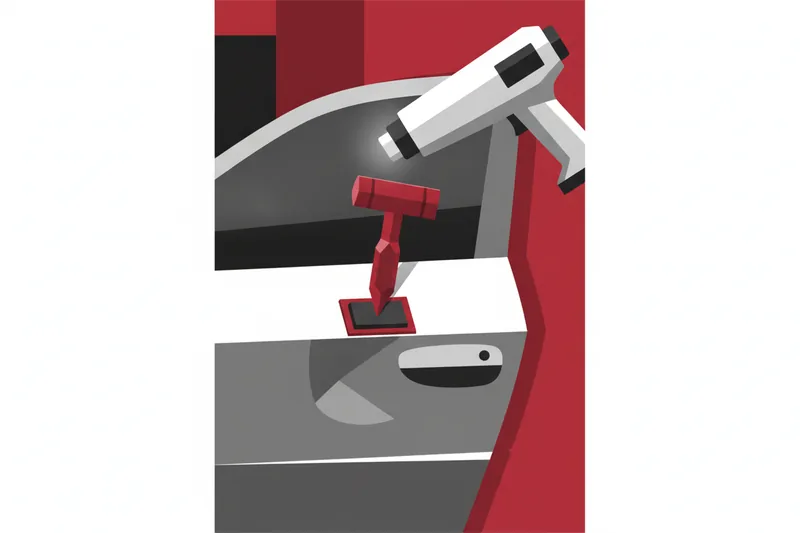
A glue tab is the exterior attachment that carries the pulling force from the glue to the slide hammer, bridge puller, or hand puller. Three variables decide whether it's the right one for a given dent: base shape, size, and material.
Round vs square base
A round base spreads load evenly around a roughly circular low spot, which is why it's the default for hail dents and small door dings. A square base concentrates more surface contact along its edges, which helps it resist twisting when the pull isn't perfectly perpendicular to the panel — useful on dents near a bodyline or an edge, where a round tab tends to rock.
A tab such as the Round Tab 50/1.97'' fits this role well, since its larger round footprint gives a stable, even grip on shallow, open-panel hail dents rather than concentrating force at one point.
Aluminum vs plastic tabs
Aluminum tabs conduct heat quickly, which matters for hot-melt work where the tab needs to warm with the glue, and they hold up under repeated sharp slide-hammer impulses. Some cold-glue tabs are plastic for this reason, lighter and not transferring heat to the puller's hand, though many cold-glue systems built around reuse rely on metal tabs instead. Shops running high hail volumes tend to stock both, since the dent count on one panel can mix shallow and deep damage that calls for different hold characteristics.
Center pull vs edge pull
A center pull applies force straight up from the middle of the dent, which is what most round tabs and most hail work are built around. An edge pull works a dent that sits against a crease, a flange, or a bodyline, where pulling from the geometric center would distort the surrounding line instead of restoring it — here a square or elongated tab usually seats more securely. Manufacturers such as Glexo build their tab ranges around this split, offering both round and square bases sized for the two pull types rather than one universal shape.
The Hail Crease PDR Tab is built for exactly this geometry, shaped to seat along a crease or flange line rather than rock the way a round tab does when the pull isn't centered.
Quick Picks by Repair Need
- Blue Snatcher PDR Glue — light to medium dents needing a smooth center pull
- Anson PDR Tuggin' Teal — small to mid dents needing secure square-base hold
- Cactus Green PDR Glue — general-purpose tabbing in moderate shop temperatures
- KECO — shops running a full glue-pull system across dent sizes
Blue Snatcher is positioned as a center-pull glue, which fits the repetitive, redundant pulling that hail work demands on mostly round, mostly shallow dents. Anson PDR Tuggin' Teal is a 13mm square-base tab, built for the edge-pull geometry that a round tab handles poorly — a reasonable pick when the damage sits near a line or panel edge rather than in open sheet metal. Cactus Green is marketed as a general-purpose glue for painted panels, which makes it a sensible default when the shop isn't running at a temperature extreme and the paint is in normal, uncontaminated condition rather than coated or aged. KECO is named as a full glue-pull repair system rather than a single glue or tab, which suits a shop standardizing its whole workflow instead of picking components individually.
None of these four is a universal answer for contaminated or coated paint — that scenario depends more on surface preparation before the tab ever goes on than on which tab or glue is chosen, which the later section on dent and temperature matching covers directly.
How We Evaluated These Glue Tabs
Picking "best" without a method is just an opinion, so the comparisons here are built on three criteria a technician actually feels in the field: hold strength under the pull type the tab is designed for, the ambient temperature range the glue pairing is described as suited to, and how the tab/glue combination performs on a surface that isn't freshly cleaned factory paint. Options were kept to what the market's own listings claim about them — center-pull versus edge-pull suitability, cold versus hot-melt chemistry, general-purpose versus niche use — rather than ranked by popularity or price. Where a listing doesn't specify a working temperature or surface tolerance, that gap is stated rather than filled in with a guess, since a technician relying on this comparison needs to know what's actually established versus what still has to be checked on the glue's own packaging.
Side-by-Side Comparison: Tab Shape, Pull Type, and Glue Pairing
| Option | Product type | Pull type suited | Notes |
|---|---|---|---|
| Blue Snatcher PDR Glue | Cold glue | Center pull | Described for light to medium dents with a smooth pull |
| Anson PDR Tuggin' Teal | Glue tab, square base, 13mm | Edge pull | Square base suits dents near a crease or edge |
| Cactus Green PDR Glue | Cold glue | Center or edge, general use | Positioned as a general-purpose painted-panel glue |
A few other names come up often in technician forums and aren't a clean fit for a single table row because they mix tabs, glues, and full systems. Tabweld and Tequila fire are both reported by technicians specifically for pulling an edge, which puts them in the same use case as a square-base tab rather than a center-pull one. Sergio Silver is sometimes mentioned among hot-melt PDR glue options, a different method from the cold-glue products above — hot-melt remains a current, valid choice for its own set of dents and isn't a leftover technique cold glue replaced. Willey Quick's tabs and matching glue get mentioned for their ease of handling rather than any stated performance edge, and Burro, a separate manufacturer brand, is known for glue tabs, hot glue, hand pullers, and window wedges rather than a single cold-glue product with a stated pull-type specialty.
Cold glue vs hot glue by working conditions
Cold glue is a ready-to-use, reusable tacky or viscoelastic compound — it isn't a two-part adhesive and it isn't a structural glue, so it comes off a reusable tab without the heat and scraping a hot-melt job needs. Hot-melt adhesive, the preferred term for what's casually called hot glue, still has its place: it tends to suit deeper, more stubborn dents where a stronger initial bond matters more than quick tab reuse. There's no fixed sequence that says one goes before the other — the repair plan, not a rule of thumb, decides which the dent calls for.
Matching Tabs to Dent Size, Location, and Working Temperature
Temperature bands for glue selection
Ambient temperature changes how a cold glue behaves on the tab: a formula that tacks up well in a cool bay can go too soft to hold a sharp pull on a hot afternoon, and a glue built for heat can feel sluggish and under-tacky in a cold shop. Some cold-glue lines split into at least two formulas for this reason — a standard version for moderate conditions and a second one for heat — so the glue needs to be matched to the day, not just the dent. The usual dividing line sits around 86°F/30°C: a formula suited to conditions up to that point is paired with a separate formula for work above it. Pull dynamics matter too: a rigid, quick-setting glue suits a sharp, shock-style pull, while a more elastic glue suits a slow, sustained one.
Surface prep before tabbing
A tab is only as reliable as the surface it's bonded to. Surface preparation here means chemical cleaning — isopropyl alcohol or a PDR-specific degreaser — to strip wax, ceramic coating, liquid glass, or road film, any of which acts as a separator and cuts glue adhesion even on a visually clean panel. Older paint, protected finishes, or a car that's recently been through a ceramic-coating detail are exactly where a technician gets a weak tack despite doing everything else right, and skipping this step is the most common reason a correctly chosen tab still lets go mid-pull.
Where Each Pick Falls Short
Blue Snatcher's center-pull strength doesn't carry over to edge or crease work, where a square-base tab holds better. Anson PDR Tuggin' Teal's 13mm square base is sized for small to mid damage — it isn't described as a fit for larger, deeper dents that need a bigger footprint. Cactus Green is a general-purpose glue, which means it isn't positioned as the sharpest choice at either temperature extreme or on heavily contaminated paint. KECO is a full system rather than a single glue or tab, so a shop that only needs one component is paying for infrastructure it may not use.
No single tab or glue on this list is the right call for every dent a shop sees in a week — base shape, pull type, ambient temperature, and surface condition each rule options in or out before brand reputation ever enters the decision. Browsing a category of glue tabs and cold-glue systems organized by these working conditions, including Glexo's range, is a faster way to narrow the choice than testing brands one at a time on a live job.